
Field notes / DE
Klappgriff WC: Procurement Comparison for German Public and Commercial Washrooms
Comparing hinged WC support rails for German projects at tender stage: locking and load documentation, grip and finish options, and the submittal records to require from suppliers.
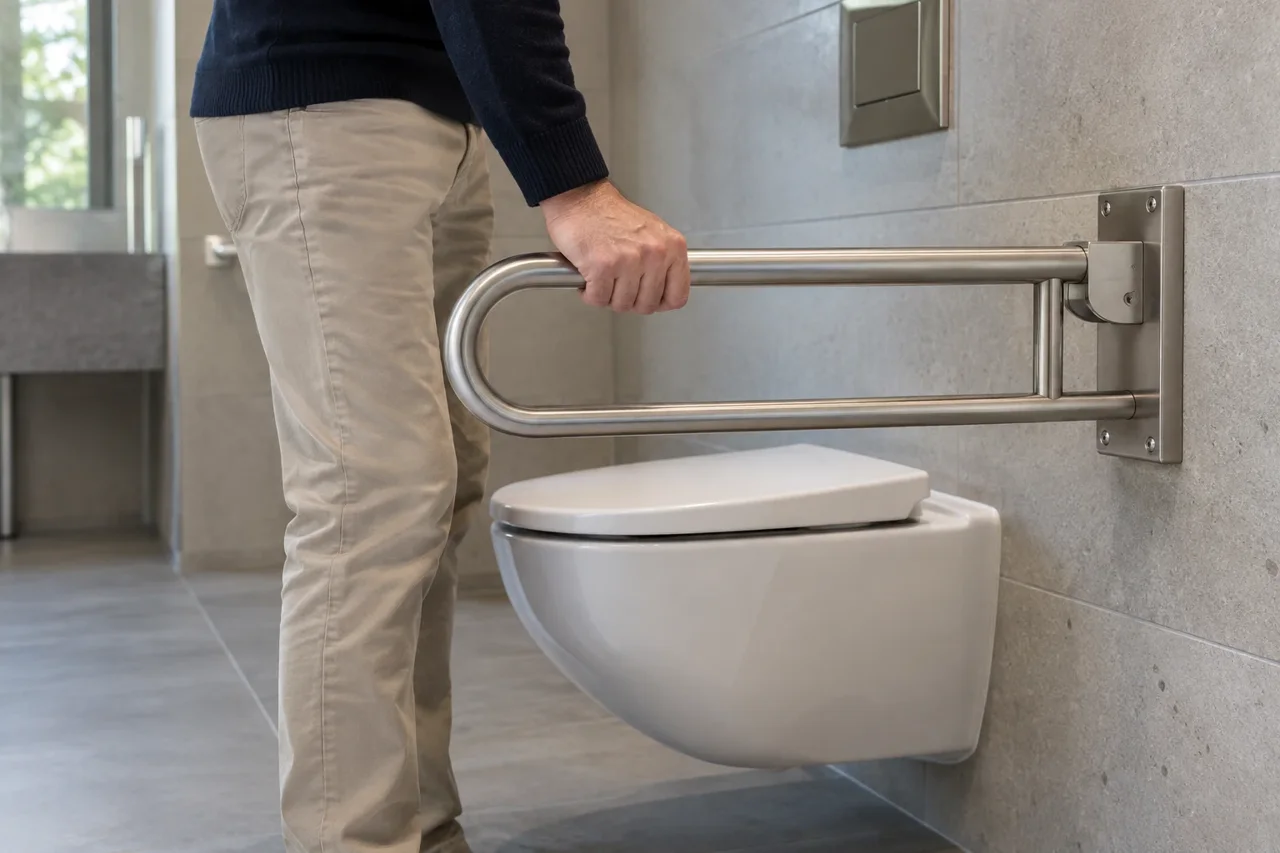
A Klappgriff at a WC is a hinged, wall-mounted support rail that folds up when not in use and must lock securely in the horizontal position. In German public and commercial washrooms, the key procurement questions are not just dimensions and finish, but whether the supplier can document the rail's load assumptions, locking behaviour and mounting requirements in a form your specifier and installer can verify.
This article is about Germany. Requirements for publicly accessible buildings depend on the building type and the applicable state building regulations. The federal accessibility office (Bundesfachstelle Barrierefreiheit) identifies DIN 18040-1 as a recognized planning framework for publicly accessible buildings, but the project must confirm which rules apply and how they are interpreted for the specific building. A rail alone cannot establish that a washroom is accessible. See https://www.bundesfachstelle-barrierefreiheit.de/DE/Fachwissen/Gebaeude/gebaeude_node.html
Why the Klappgriff Needs Stronger Documentation Than a Fixed Rail
A fixed Haltegriff is a passive component. A klappgriff is a moving assembly with hinges, a locking mechanism and a defined swing path. At procurement stage, this means the submittal file should cover more:
- The manufacturer's stated load assumptions for the complete assembly, including the locking position
- How the locking mechanism behaves and what maintenance it requires
- The wall construction the product is designed for, and any reinforcing or backing the installer must provide
- Clearing and swing path requirements relative to adjacent fittings
Do not accept a general statement that a rail is suitable for accessible WCs as a substitute for model-specific documentation. Ask each supplier for the documents relating to the exact model quoted.
Comparing Locking and Load Evidence Between Suppliers
When two or more klappgriff models are shortlisted, compare them on the quality of their paperwork as much as on price. Useful comparison points include:
- Whether load information is stated per model, or only as a generic catalogue claim
- Whether the locking mechanism description is specific enough for the installer to understand the moving parts and wear points
- Whether the manufacturer states maintenance or inspection intervals for the hinge and lock
- Whether spare parts availability is documented
Request written confirmation of any verbal claim. If a supplier cannot state the load basis or the locking behaviour for a specific model, record that gap in the submittal file and let the project designer decide whether it is acceptable.
Grip Profiles and Finish Options
Klappgriffe are commonly offered in stainless steel with different tube profiles and surface treatments. At tender stage, compare:
- Grip profile and diameter options, and how the surface reads for users with limited grip strength or wet hands
- Surface finish, including how it will withstand the facility's cleaning regime
- Compatibility of the finish with disinfectants used in care or healthcare settings
- Whether the manufacturer publishes cleaning and care instructions for the model
Ask for cleaning compatibility documentation rather than relying on general statements about stainless steel. A finish that looks identical in a catalogue can behave very differently under a specific cleaning regime.
Wall Construction and Anchoring Prerequisites
A klappgriff transfers load into the wall through its fixings and the hinge assembly. The suitability of the wall construction, any required backing or reinforcement, and the fixing method are structural and installation decisions. Refer them to the project designer and a qualified installer. Do not accept anchoring guidance from a catalogue as confirmation that a given wall is adequate.
For Flanso's general framing of wall prerequisites and why no-drill alternatives are unsuitable for commercial washrooms, see https://flanso.com/#anchoring
Submittal Records to Require From Suppliers
Build the enquiry so that each supplier returns a consistent package. A typical request list:
- Model-specific product data for the quoted klappgriff
- The manufacturer's stated load assumptions and their basis
- Locking mechanism description and maintenance requirements
- Cleaning and care instructions for the specified finish
- Wall construction prerequisites and fixing requirements as stated by the manufacturer
- Spare parts and availability information
File the returned documents against the tender line item so the installer, the facility operator and any future inspector can trace which model was specified and on what documented basis.
Project Checklist
- Confirm the applicable state building requirements and building type with the project designer; use the Bundesfachstelle Barrierefreiheit guidance as the starting framework
- Define the klappgriff line item with model-specific documentation requirements, not generic accessibility claims
- Request load and locking documentation per model from every shortlisted supplier
- Request cleaning compatibility information for the specified finish
- Refer wall construction and anchoring decisions to the project designer and qualified installer
- Record all returned submittals against the tender file
- Ask manufacturers, including Flanso, for model-specific information directly rather than assuming claims apply across a range; enquiries can be sent via https://flanso.com/#contact
Photographs of installed rails illustrate products only. They do not demonstrate that a particular installation meets the requirements applicable to your project.