
Field notes / DE
WC Stützgriff: Procurement Comparison for German Care and Commercial Washrooms
Compare fixed and hinged WC Stützgriff types for German projects, and find out which grip, surface, load and locking documentation to request from suppliers at tender stage.
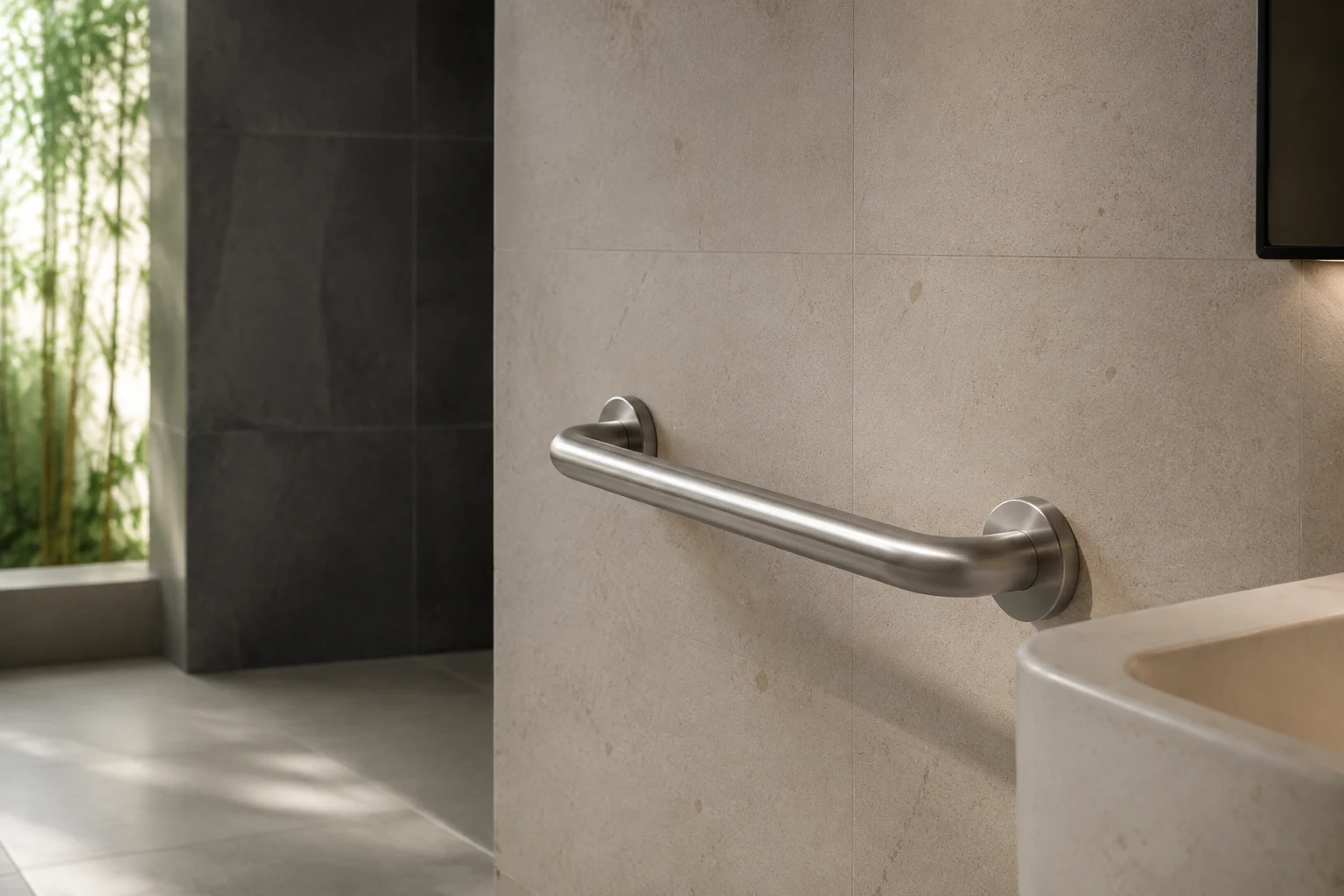
Choosing a WC Stützgriff for a German care or commercial washroom is a procurement decision before it is a placement decision. The two main types, fixed rails and hinged (klappbar) rails, suit different transfer scenarios and space constraints, and each demands different evidence from suppliers. This article compares both types at tender stage and lists the documentation a specifier or project buyer should request, without prescribing installation or claiming that any rail alone makes a washroom accessible.
The regulatory context in Germany
For publicly accessible buildings in Germany, the federal accessibility office (Bundesfachstelle Barrierefreiheit) identifies DIN 18040-1 as a recognized planning framework. The project must also check the applicable state building requirements (Bauordnungen) and the building type, because these determine what is required and who verifies it.
The key point for buyers: a rail product is a component within a planned, accessible WC layout. The project designer (Objektplaner) decides rail types, positions and quantities as part of the overall accessible building concept. No individual product, however it is described in supplier literature, can establish building accessibility on its own. Source: https://www.bundesfachstelle-barrierefreiheit.de/DE/Fachwissen/Gebaeude/gebaeude_node.html
Fixed versus hinged WC Stützgriff types
A fixed Stützgriff is a permanently mounted rail. In supplier literature, fixed rails for WC zones are typically horizontal one-hand rails or L-shaped (L-Form) combinations. They offer constant availability, no moving parts and therefore fewer inspection points over the product's life. The trade-off is that a fixed rail occupies its footprint permanently and may conflict with transfer paths or care staff access in tighter rooms.
A hinged Stützgriff (often listed as Klappgriff or stützgriff klappbar) folds up against the wall when not in use. This is common where a side transfer from a wheelchair must be possible, or where the WC must also serve people who do not need support. Hinged types introduce moving parts, so procurement must look closely at the locking mechanism, hinge construction and the manufacturer's maintenance guidance.
The comparison at tender stage should therefore consider:
- Transfer scenario and whether the rail must be removable from the transfer path
- Who will use the room (residents, visitors, staff, care personnel)
- Wall construction and the load path, which differs between the two types in practice
- Lifecycle effort: fixed rails have fewer inspection points, hinged rails need locking checks
Refer the final type selection to the project designer, who owns the accessible layout decisions.
Grip and surface options to compare
Whichever type is chosen, the grip and surface choice affects daily usability and cleaning regimes:
- Material: stainless steel is standard in German commercial washrooms for durability and cleaning compatibility; coated or nylon-sleeved grips may improve thermal comfort and wet-hand grip but require manufacturer guidance on cleaning agents.
- Profile: cylindrical grips are common; ergonomic or slightly flattened profiles are offered by some suppliers. Ask each manufacturer for grip dimension and surface documentation rather than assuming equivalence across ranges.
- Surface condition: inspect samples for finish quality at welds, flanges and joints, since these are where cleaning wear shows first in high-traffic settings.
Request the manufacturer's cleaning and care instructions for each finish, and check compatibility with the facility's existing cleaning regime before ordering.
Load and locking documentation: what to request
German procurement practice expects the manufacturer's documentation, not marketing claims, to back any load-bearing statement. In your enquiry, ask for model-specific documents:
- The manufacturer's stated load capacity for the exact model and mounting method, with the test or calculation basis the manufacturer provides
- For hinged rails: the manufacturer's documentation on the locking mechanism, including how the lock is checked and any maintenance interval stated by the manufacturer
- Mounting instructions and any wall construction prerequisites the manufacturer states, which the qualified installer and structural reviewer must assess
- Spare parts availability for hinge, lock and fixings
- Cleaning and care instructions per finish
Do not accept a general product family claim as evidence for a specific model. If a supplier states a load value, ask which document it comes from and whether it applies to the model, the rail length and the wall construction in your project. Note that any test verification depends on the wall structure and installation, which is the responsibility of the project designer and qualified installer, not the product listing.
Structuring the enquiry around official guidance
Cite the applicable German framework in the enquiry so suppliers answer against it. A useful structure:
- State the project type and that DIN 18040-1 planning requirements apply where the Bundesfachstelle Barrierefreiheit guidance is relevant to the building: https://www.bundesfachstelle-barrierefreiheit.de/DE/Fachwissen/Gebaeude/gebaeude_node.html
- List the models under consideration, fixed and hinged, and request the documentation listed above per model
- Ask explicitly how each supplier's documentation addresses the placement decisions the project designer has made, without asking the supplier to confirm building compliance
- Keep supplier responses in the submittal file so completion records trace back to tender answers
Coordinating anchoring early
Support rails only perform as specified when the wall construction and fixings suit them. Coordinate the anchoring scope with the qualified installer and structural reviewer before ordering, and record wall construction information in the project file. See the Flanso anchoring overview at https://flanso.com/#anchoring for context on what to prepare, then refer structural decisions to the responsible professionals.
Project checklist
- Confirm the applicable state building requirements and building type with the project designer
- Note that DIN 18040-1 is the planning framework for publicly accessible buildings per the Bundesfachstelle Barrierefreiheit, and record the citation in the specification
- Decide fixed versus hinged type per WC location with the project designer
- Request model-specific load capacity documentation and its basis from each supplier
- For hinged models, request locking mechanism documentation and the manufacturer's maintenance guidance
- Request mounting instructions, wall construction prerequisites and cleaning instructions per finish
- Confirm spare parts availability for hinges, locks and fixings
- Coordinate wall construction and fixings with the qualified installer and structural reviewer
- File all supplier responses and installation-related records for completion documentation
For model-specific information, finishes or documentation requests, send your enquiry via https://flanso.com/#contact.