
Field notes / US
ADA Compliant Grab Bars: What Evidence to Request Before You Specify
In the US, “ADA compliant” describes how a grab bar meets the 2010 ADA Standards. Learn what documentation to request from suppliers and what proves an installed assembly.
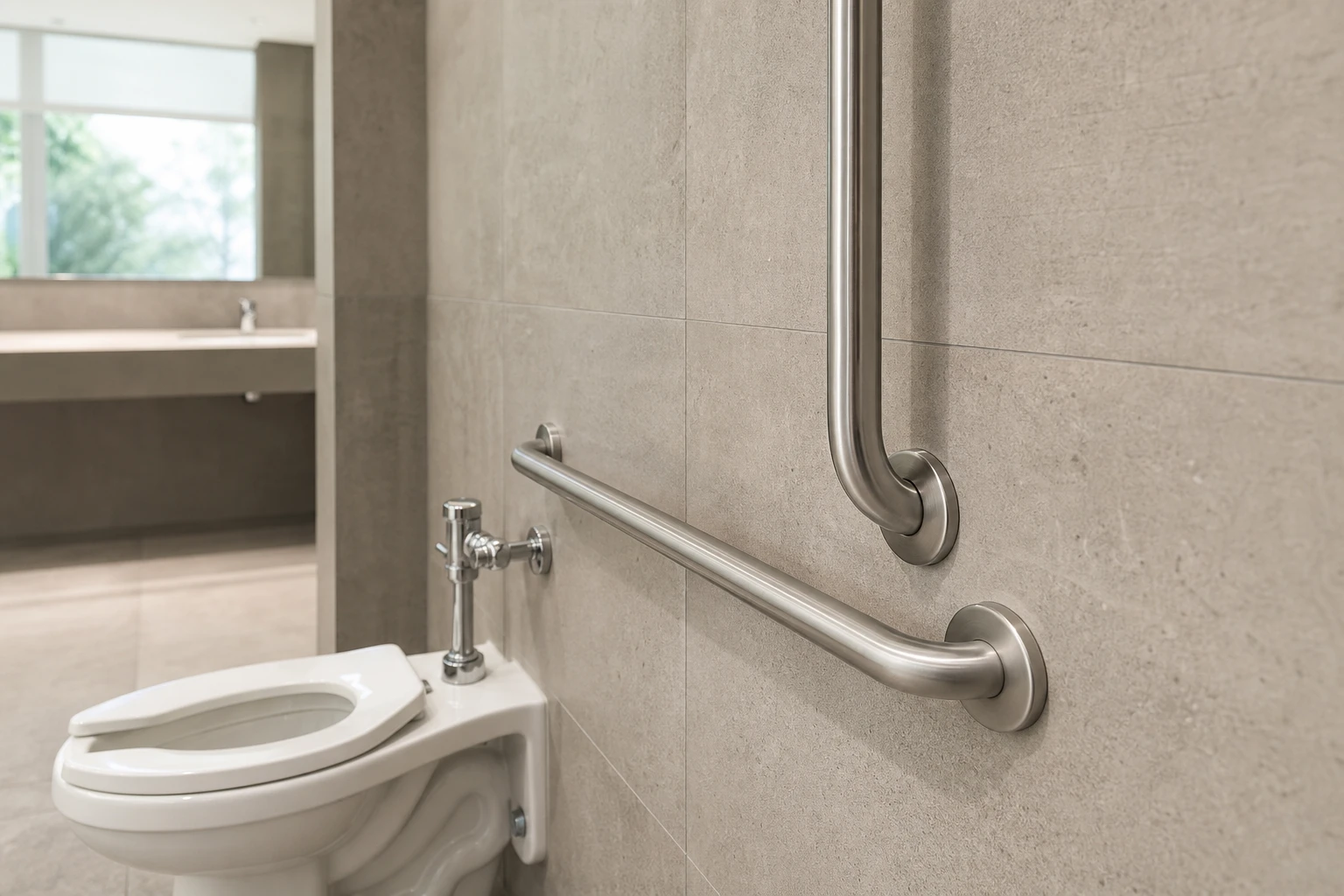
In the United States, “ADA compliant grab bars” is a claim about how a product and its installation relate to the 2010 ADA Standards for Accessible Design. A compliant grab bar is not just a bar with the right shape. Compliance depends on the bar’s dimensions, its height and positioning, and critically on the wall and blocking behind it. When a supplier describes a grab bar as ADA compliant, ask what that claim actually covers. Separate the requirements written in the standard from the evidence for the selected product and installed assembly.
What the ADA Standards Actually Cover
The US Access Board provides the official ADA Standards text. Section 609 sets out requirements for grab bars. The standard covers the gripping surface, clearance, height, structural strength and positioning in water closets, bathtub and shower compartments. You can read the full text at https://www.access-board.gov/ada/.
Key dimensional requirements include:
- Circular cross-section outside diameter between 1.25 and 2 inches, with 32 mm and 51 mm given in the standard (section 609.2.1)
- Horizontal grab bar height generally measured to the top of the gripping surface, between 33 and 36 inches (840 to 915 mm) above the finish floor (section 609.4)
- Structural strength assessed for the grab bar, its fasteners, its mounting and the supporting structure under a 250 pound (1112 N) force (section 609.8)
Two important cautions apply to the height figure. The 33 to 36 inch range is the general rule. Separate provisions apply to children’s water closets and to the lower bathtub back-wall rail, so that range should not be applied to those exceptions.
Compliance Applies to the Assembly, Not Just the Bar
Section 609.8 is the clearest example of why a product claim alone is never enough. It assesses the grab bar together with its fasteners, mounting and supporting structure under a 250 pound (1112 N) force. A bar that meets every dimensional requirement can still fail to deliver a compliant installation if the supporting wall or reinforcement is inadequate, or if fasteners are unsuitable for the substrate.
This means the evidence chain has two parts. First, evidence about the product. Second, evidence about the installed assembly, which only exists once the wall build-up and fixing method are known. Request both, and treat any supplier claim that only addresses the bar itself as incomplete.
Evidence to Request About the Product
When a grab bar is described as ADA compliant, ask the supplier to state which requirements the claim covers. Useful requests include:
- Written confirmation of the gripping surface diameter, so you can check it against section 609.2.1
- Documentation of the gripping surface shape and any clearance claims, referencing the relevant sections
- Identification of any independent testing the manufacturer has commissioned, with the test report itself rather than a summary
- Clear statements of what the product documentation does not cover, such as structural performance of the wall
Keep the claims specific. “Meets ADA requirements” is a marketing phrase. A document that states the outside diameter, the material and the basis for any performance claim lets your project team verify it against the standard at https://www.access-board.gov/ada/.
Evidence to Request About the Installed Assembly
For the installed assembly, coordinate the project designer, qualified installer and supplier. Product documentation should inform the project-specific assessment of the supporting wall and fixing system. Documentation to gather during the project includes:
- The specified wall build-up and blocking or reinforcement detail for each grab bar location
- The fastener specification matched to the substrate
- Confirmation that the installed height, measured to the top of the gripping surface, falls within section 609.4 or the applicable exception
- A note of who verified the assembly against section 609.8 and by what method
No product certificate substitutes for this. The standard assesses the system, so the system must be documented.
Common Misreadings That Create Risk
Specifiers and buyers frequently run into three issues. First, the 33 to 36 inch height range is quoted as universal when it has exceptions for children’s water closets and the lower bathtub back-wall rail. Second, a product described as “ADA certified” is assumed to guarantee compliance of the finished installation, which it cannot, because the supporting structure is part of the requirement. Third, the 250 pound figure from section 609.8 is treated as a product rating rather than a requirement placed on the bar, fasteners, mounting and supporting structure together.
Where a project falls under a different regime, such as state accessibility codes or other standards, confirm which document governs before relying on any single source.
How Flanso Supports Specification
Ask Flanso for model-specific dimensions and mounting information so your project team can check the proposed configuration against the applicable requirements. We do not claim that a product listing proves a compliant installation, because the standard itself assesses the assembly. For structural and installation decisions, refer to your project designer and a qualified installer.
If you need dimension sheets or anchoring guidance for a project enquiry, see our anchoring overview at https://flanso.com/#anchoring or contact the team at https://flanso.com/#contact.
Project Checklist
- Confirm which accessibility standard governs your project and note the jurisdiction
- Request written product dimensions, including gripping surface diameter per section 609.2.1
- Check specified heights against section 609.4, and identify any exceptions that apply to the location
- Confirm the wall build-up, blocking and fastener specification for every grab bar position
- Document who assessed the installed assembly against section 609.8 and how
- Keep test reports and manufacturer statements on file, not just marketing claims
- Have the project designer and qualified installer sign off positioning and structural details
For the authoritative text of every requirement cited above, read the 2010 ADA Standards at https://www.access-board.gov/ada/.