
Field notes / US
Shower Seat ADA: What to Verify Before Ordering for a US Project
A guide to the ADA sections that apply when a shower seat must support compliance in a US commercial shower, including clearances, grab bar coordination and documentation.
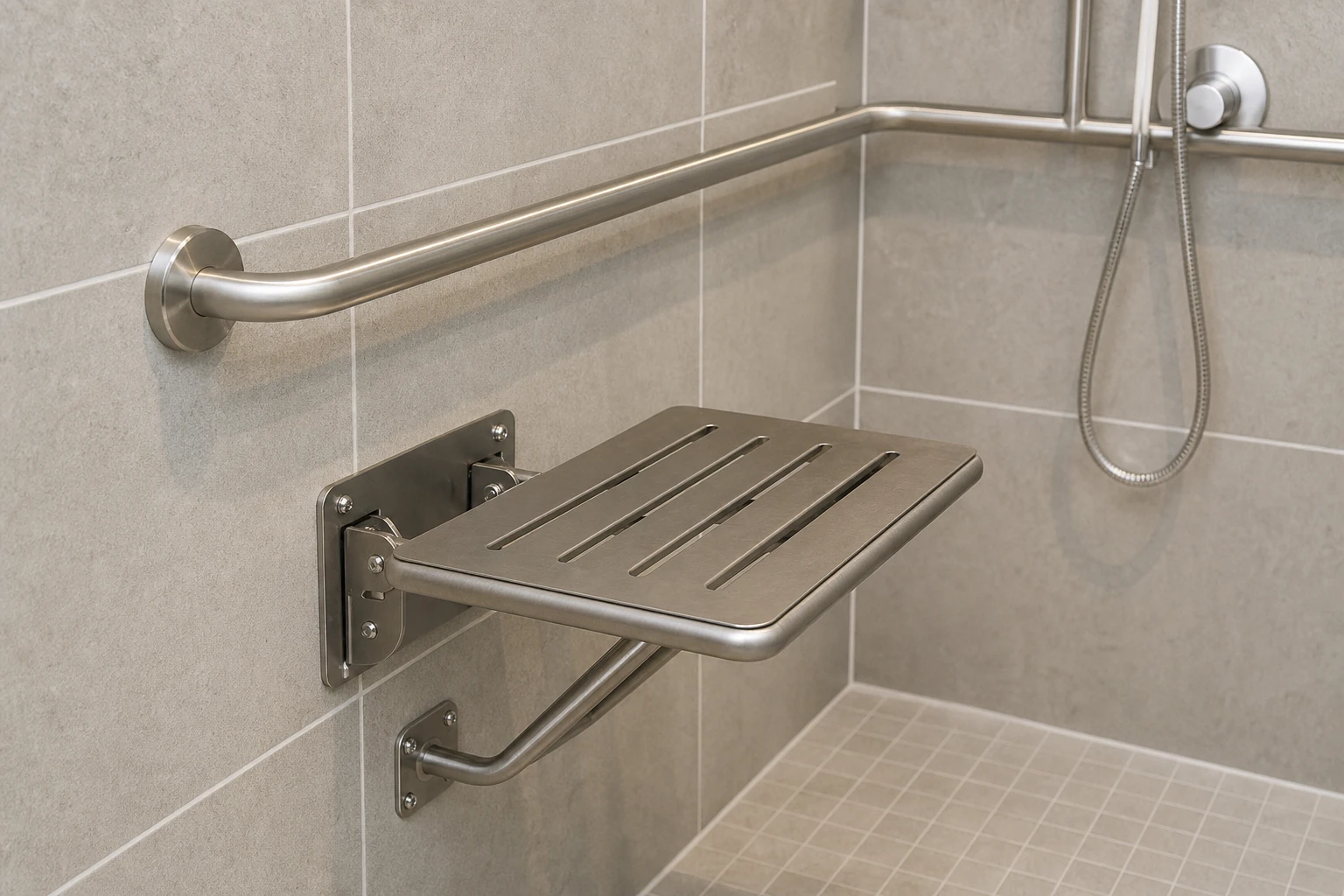
When a shower seat is intended to support an ADA-compliant shower in the United States, the seat itself, the transfer space around it and the grab bars beside it all fall under the 2010 ADA Standards issued by the US Department of Justice. The US Access Board publishes the official combined text at https://www.access-board.gov/ada/. Section 610 addresses seats. Section 609 addresses grab bars. Verify both, plus the shower compartment clearances, against the official text before ordering anything.
Confirm the seating requirement for the shower type
Section 610 of the ADA Standards sets out requirements for seats in bathing compartments. Which provisions apply depends on the type of shower compartment and the fixture it serves, so the first verification step is simply identifying the shower type on the drawings. A seat specified for a roll-in shower is not specified the same way as one for a transfer shower, and the standard treats these differently.
Read section 610 in the official text at https://www.access-board.gov/ada/ rather than relying on secondary summaries, because summaries frequently conflate seat requirements with grab bar requirements. If the seating is fixed, its structural support is part of the wall assembly conversation, and your project designer should confirm how that support is achieved.
Check the clearances around the seat
A compliant seat is only useful if the space around it works for transfers. The shower compartment clearances in the ADA Standards sit alongside the seat provisions, and the transfer space in front of the seat is part of that review. Your project designer should confirm the compartment dimensions and turning or transfer clearances against the official standard for the specific shower configuration on your plans.
Two practical checks belong in this review:
- Does the seat sit within the compartment so that it does not encroach on required clearances?
- Is the adjacent wall space available for the grab bars the configuration requires?
Do not sign off seating and grab bar locations independently. They are coordinated elements of the same layout.
Coordinate grab bars against section 609
Grab bars beside the seat are covered by section 609, and the seat height interacts with grab bar placement. Section 609.4 generally measures horizontal grab bar height to the top of the gripping surface, between 33 and 36 inches (840 and 915 mm) above the finish floor. Separate provisions apply to children's water closets and the lower bathtub back-wall rail, so do not apply this range to those exceptions.
Two other parts of section 609 matter when a seat is in the specification:
- Section 609.2.1 sets the circular grab bar outside diameter between 1.25 and 2 inches, given in the standard as 32 and 51 mm.
- Section 609.8 requires the grab bar, fasteners, mounting and supporting structure to withstand a 250 pound (1112 N) force. This is a requirement of the standard for the installed assembly, not a product test figure and not a Flanso test result.
Cite these sections directly in your submittals using the official text at https://www.access-board.gov/ada/.
Treat the wall assembly as part of the specification
A seat and its neighboring grab bars are only as secure as the wall behind them. Section 609.8 explicitly includes the supporting structure, which means blocking or reinforcement in a framed wall, or an appropriately assessed masonry or concrete substrate, belongs in the specification review alongside the fixtures.
Before installation is scheduled, your qualified installer should confirm the actual substrate on site against the drawings. Hidden construction often differs from the plans, especially in retrofits. Flanso covers anchoring considerations at https://flanso.com/#anchoring, but the structural decision rests with the project designer and the qualified installer, not with the product selection alone.
Ask for model-specific documentation
Describing a product as suitable for an ADA project is not the same as documenting that it meets a requirement. When you enquire about shower seats and matching grab bars, request:
- Model-specific dimension information so you can verify against the standard's figures yourself.
- Installation instructions from the manufacturer for the seat and rails.
- Material and finish information appropriate to a wet, commercially used environment.
Ask Flanso for this information per model through https://flanso.com/#contact. Do not assume that a general product description, or a photograph of an installed seat, demonstrates compliance with the standard. Compliance is assessed on the installed assembly in the completed project.
Project checklist
Before ordering a shower seat for an ADA-intended US shower:
- Identify the shower compartment type on the drawings and confirm the applicable section 610 seat provisions in the official text at https://www.access-board.gov/ada/.
- Have the project designer verify compartment and transfer clearances against the standard.
- Confirm grab bar placement, gripping-surface height under 609.4 and diameter under 609.2.1, noting the exceptions that do not use the general range.
- Confirm the wall assembly can meet the 609.8 structural requirement for grab bars, with the seat's fixing approach reviewed by the qualified installer.
- Survey the substrate on site before installation, particularly in retrofit work.
- Record the sections cited and the documentation received in your submittal file.
Keep the official Access Board text as your reference of record: https://www.access-board.gov/ada/. Structural and installation decisions should always be referred to the project designer and a qualified installer.