
Field notes / US
Keeping ADA Grab Bar Compliance Alive Over Your Facility's Life Cycle
Compliance does not end at installation. How to inspect, document and re-verify grab bars in US commercial washrooms over years of service.
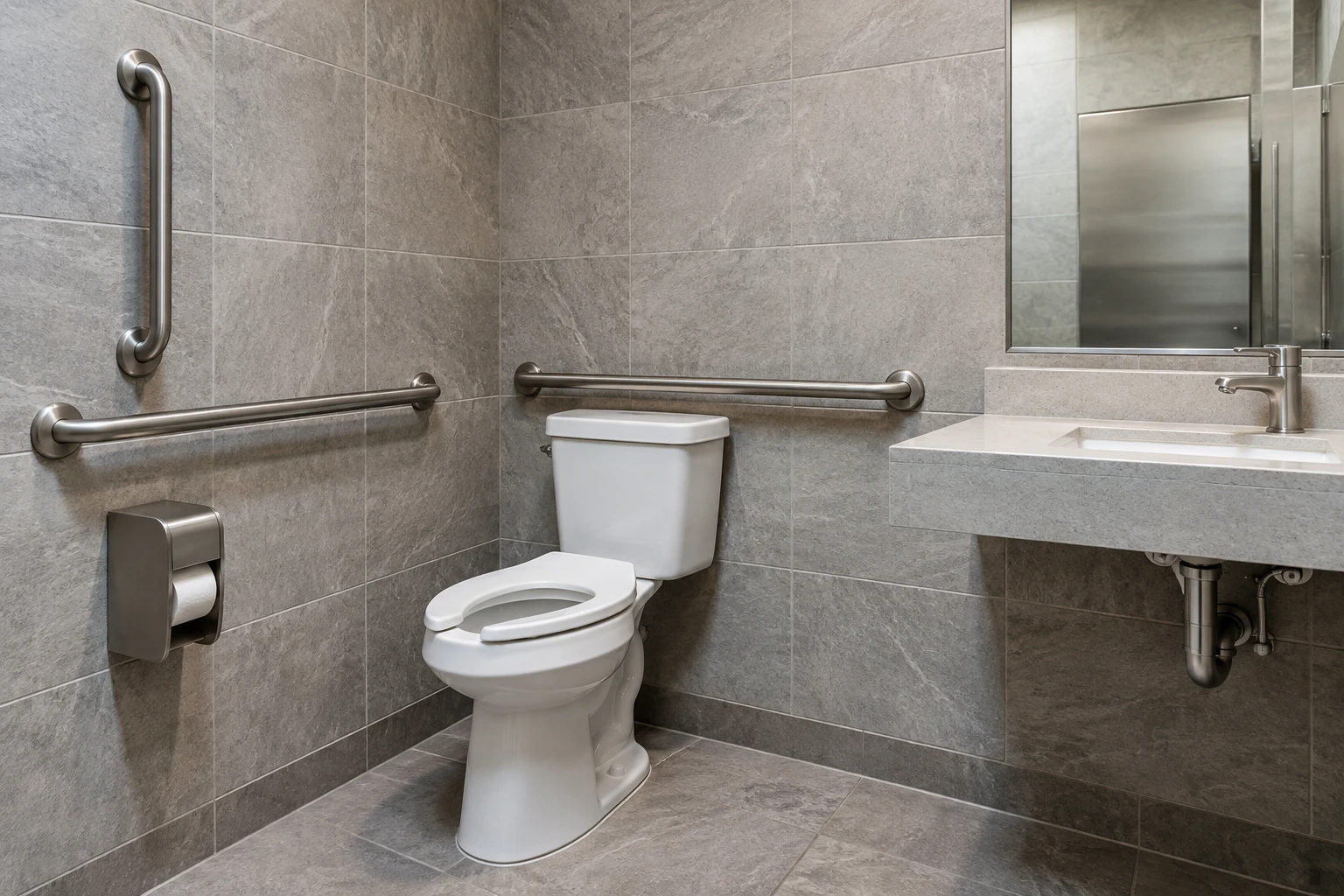
ADA grab bar compliance is not a one-time milestone. Once a commercial washroom opens, the rails, their fasteners and the supporting structure continue to carry real loads every day, and the condition of all three can change. The 2010 ADA Standards, published by the US Department of Justice and maintained in combined form by the US Access Board, remain the reference point for the life of the building, not just the handover date (https://www.access-board.gov/ada/).
What the standards require at installation and afterwards
Section 609 of the ADA Standards covers grab bars. Key provisions include:
- Section 609.2.1 sets the circular outside diameter of grab bars between 1.25 and 2 inches, with 32 and 51 mm given in the standard (https://www.access-board.gov/ada/).
- Section 609.4 generally measures horizontal grab bar height to the top of the gripping surface, between 33 and 36 inches (840 and 915 mm) above the finish floor. Separate provisions apply to children's water closets and the lower bathtub back-wall rail, so this range should not be applied to those exceptions.
- Section 609.8 assesses the grab bar, its fasteners, its mounting and the supporting structure under a 250 pound (1112 N) force. This is a standard requirement, not a product test result from any manufacturer.
Note that Section 610 addresses seats, not grab-bar requirements, and is sometimes mis-cited in maintenance documentation.
Section 609.8 is the provision most relevant to life cycle compliance. A rail that is correctly sized and positioned can still fail the standard if fasteners loosen, mounting plates crack or the wall structure behind the finish degrades. Compliance is therefore a property of the complete installation, checked over time.
Building inspection intervals into the maintenance schedule
The ADA Standards themselves do not prescribe inspection intervals. Facility managers typically set their own, informed by usage intensity, the manufacturer's maintenance documentation and the building's general inspection regime. What matters for compliance is that intervals exist, are followed and are recorded.
A practical approach for a commercial washroom:
- Fold periodic grab bar checks into existing washroom inspection rounds rather than creating a separate programme that is easy to defer.
- Increase frequency in high-traffic locations, wet areas and facilities serving older or mobility-impaired users.
- Ask each manufacturer for its recommended maintenance and inspection guidance at purchase and file it with the product record. Rail materials and mounting systems differ, and care instructions matter for stainless steel as much as fixings do.
Loose-fitting rails: repair or replace
A rail that moves under hand pressure has a defect in the load path covered by Section 609.8. Options are immediate repair or removal from service until repair is complete. Treat a wobbly rail as a priority item, not a routine defect to batch into the next quarter's works.
When a rail has been re-fixed, the repair should restore the original installation condition, including the fixings and the supporting structure, not just the visible rail. If the original manufacturer documentation is unavailable, or the repair requires touching the wall structure, the project designer and a qualified installer should decide how the installation will be verified against the standard. Avoid undocumented repairs where the wall itself has been disturbed.
Record keeping that stands up to review
Maintenance records are the facility's evidence of continued compliance. Useful records typically include:
- The original product submittal: manufacturer, model, mounting type and the documentation supplied with the order.
- As-installed information showing rail positions and the wall construction or backing each rail is fixed to.
- Inspection logs with dates, locations, findings and actions taken.
- Repair records stating what was replaced or re-fixed, who carried out the work and what was checked afterwards.
- Manufacturer maintenance and cleaning documents filed where the next contractor or auditor can find them.
Digital or paper both work. Consistency matters more than format. A record that links each rail in each compartment to a model and a service history is far more valuable than a box of mixed delivery notes.
Re-submittal when walls or fixtures change
Any alteration that touches the washroom fabric can invalidate the original compliance position. Refits that should trigger a fresh look at grab bar provision include:
- Re-tiling, re-lining or replacing partitions in a compartment.
- Moving or replacing the water closet, lavatory or shower fixtures, since rail positions are tied to fixture locations.
- Relocating plumbing that requires opening the wall.
- Changing the wall construction itself, for example from masonry to stud lining, which changes the load path behind the finish.
In these cases the specification should be re-checked against the current ADA Standards rather than copied from the previous drawing set. Section 609.8 in particular should be reviewed against the new wall construction. The project designer and a qualified installer are the right people to confirm the new arrangement, and the new as-installed information should replace the old record rather than sit alongside it.
Where manufacturers fit in
Manufacturers, including Flanso, supply product documentation such as material specifications, mounting information and care guidance. This documentation supports the specification and the maintenance record, but it does not by itself demonstrate that a given installation meets the ADA Standards; compliance depends on the installed assembly, including the wall, the fixings and the workmanship. For model-specific information on any Flanso rail, request the current documentation directly rather than assuming standard values. Guidance on anchoring and wall construction questions is available at https://flanso.com/#anchoring, and general project enquiries can be made at https://flanso.com/#contact.
Project checklist
- Confirm the facility's governing requirements against the current ADA Standards text (https://www.access-board.gov/ada/).
- Log the manufacturer, model and mounting type of every installed rail.
- File manufacturer maintenance and cleaning documents with each product record.
- Set and record inspection intervals appropriate to traffic and wet-area exposure.
- Check rails for looseness as part of routine rounds and treat defects as priority items.
- Record all repairs, including fixings and any wall work, and note how the repaired assembly was verified.
- Trigger a re-check of grab bar provision whenever walls, partitions or fixtures change.
- Replace superseded as-installed records with the new ones after any refit.
- Direct structural and installation decisions to the project designer and a qualified installer.