
Field notes / US
Suction Grab Bars in US Commercial Washrooms: A Facility Manager's Audit Checklist
How to identify suction-mounted rails during washroom inspections, document removal decisions, and prepare fixed replacement information for your specifier under US ADA requirements.
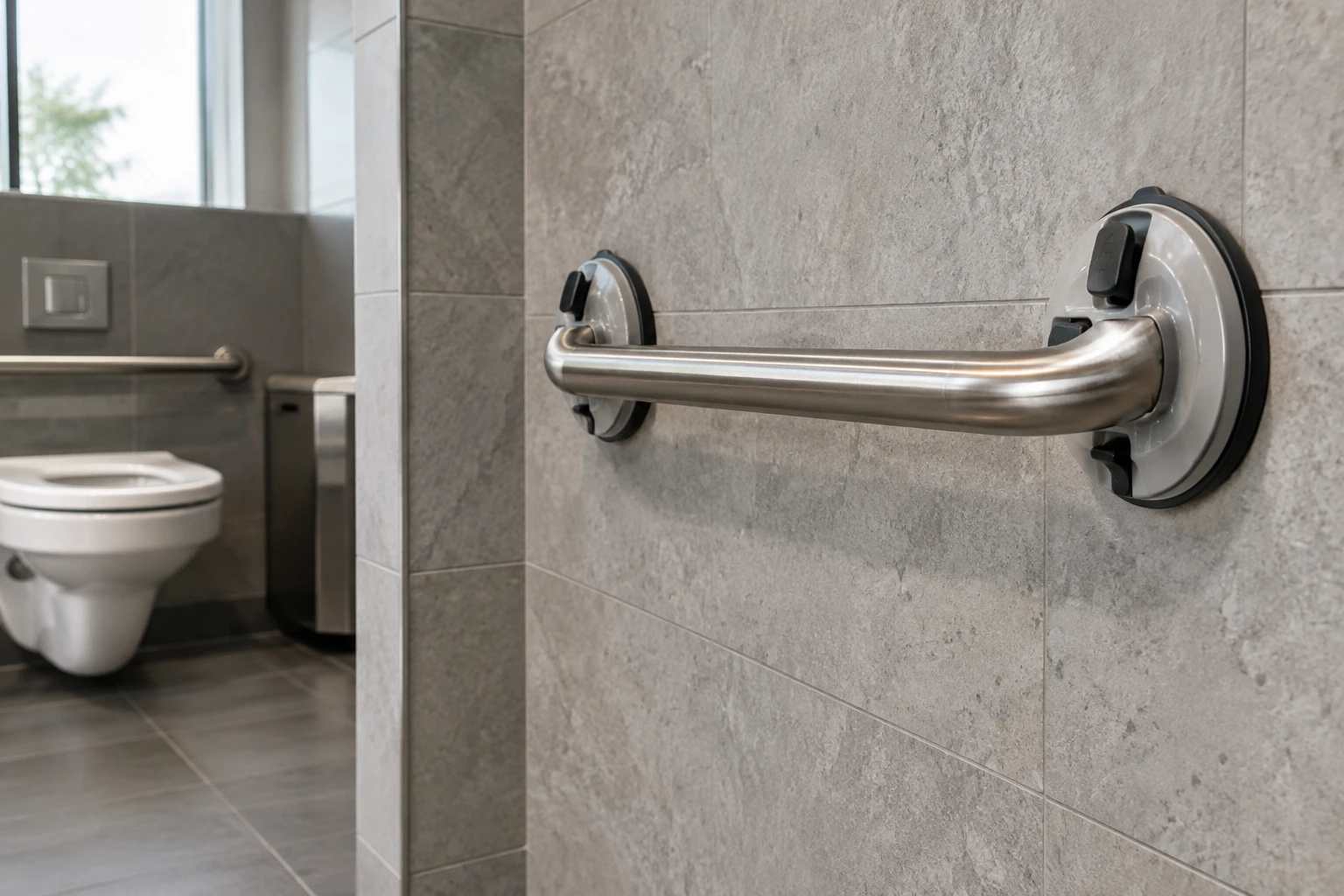
Suction-mounted grab bars should be treated as unsuitable support fittings in US commercial washrooms and flagged for removal in your survey record. They are not capable of meeting the structural performance expected of grab bars under the 2010 ADA Standards, which assess the bar, fasteners, mounting and supporting structure together under a defined force. This article gives facility managers a checklist for auditing suction rails found during inspections, recording the removal decision, and handing the specifier the right information for a fixed replacement.
Why suction rails fail the commercial test
The US Department of Justice issued its ADA Standards in 2010, and the US Access Board publishes the official combined standards text (https://www.access-board.gov/ada/). Section 609 addresses grab bars. Section 609.8 requires the grab bar, its fasteners, its mounting and the supporting structure to withstand a defined force. A suction cup relying on smooth-surface adhesion has no meaningful fastening into the wall structure, so the fitting itself cannot demonstrate the load path that section 609.8 describes.
Suction rails are designed for occasional balance assistance in domestic settings. In a commercial washroom they present two risks: a user may load the rail expecting full support, and the fitting may release without warning. Suction cups also degrade with moisture, temperature changes and cleaning regimes, so a rail that held on inspection day cannot be assumed to hold next month.
Recognising unsuitable fittings in the survey record
During inspection, log every rail that meets any of the following descriptions:
- Any rail attached by suction cups, vacuum pads or adhesive pads, with or without a lever-lock mechanism
- Rails mounted to tile, glass, acrylic or other smooth finishes with no visible fixings into structure
- Rails that rotate, flex or detach under light hand pressure
- Rails with no manufacturer documentation on file, or documentation that describes domestic use only
- Rails positioned where users would reasonably expect a compliant grab bar, such as beside a water closet or in a shower
Photograph each fitting, note its location and record the mount type in the survey record. Where a suction rail sits in a position that appears intended to serve an accessible fixture, note that too, because the replacement scope will differ from a rail that was never part of the accessible provision.
Separating the two decisions: removal and replacement
Keep removal and replacement as distinct line items. Removal of an unsuitable fitting is usually straightforward and can proceed on your authority as facility manager, with the wall made good afterwards. Replacement triggers the ADA requirements and belongs with your project designer or specifier.
Record for each removal: the reason (suction mount, no documentation, deteriorated condition), the date, who authorised it, and whether a temporary alternative support measure is needed in the interim. Avoid leaving a fixture position with no support while the replacement is procured if users depend on it.
Documenting the removal decision
A short audit trail protects the facility if the decision is questioned later. For each suction rail, record:
- Location reference and photographs
- Mount type and observed condition
- The standard reference you relied on: ADA section 609, including 609.8 for structural performance (https://www.access-board.gov/ada/)
- The removal decision, date and authorising role
- The follow-up action: specification request raised, target date, responsible party
This turns a casual observation into a defensible record that feeds directly into a prioritised upgrade plan.
What fixed replacement information to hand to the specifier
Your survey record should give the specifier everything needed to size and position a fixed replacement without a second site visit. Include:
- The location, the fixture it serves and the wall type as far as you can identify it (partition, masonry, stud with unknown backing)
- Photographs of the wall, the removed rail's footprint and the surrounding clearances
- The observed use pattern: which users rely on the rail and from which side they transfer
- The relevant sections of the ADA Standards for the specifier to verify: section 609 generally, 609.2.1 for gripping-surface diameter, 609.4 for mounting height to the top of the gripping surface, and 609.8 for structural performance (https://www.access-board.gov/ada/)
- Any noted exceptions the specifier should assess rather than assume, such as separate provisions for children's water closets or lower bathtub back-wall rails, which sit outside the general height range
Note that section 610 of the ADA Standards addresses seats, not grab-bar requirements, so do not cite it as the basis for rail placement or strength. Fixed rails and structural wall assessment belong with the project designer and a qualified installer; the wall construction and load path questions behind finished surfaces need professional assessment, not a facilities guess. For anchoring background, see https://flanso.com/#anchoring.
Product evidence to request from suppliers
When the specifier is ready to select a replacement, ask suppliers for model-specific documentation rather than accepting generic claims:
- Confirmation of the gripping-surface diameter range against section 609.2.1
- Mounting details and the wall conditions the model is designed for
- Evidence of how the bar, fasteners, mounting and supporting structure are intended to satisfy section 609.8
- Finish, material and cleaning-compatibility information for your maintenance regime
Flanso can discuss fixed rail options for commercial washrooms and supply model-specific information on request via https://flanso.com/#contact. Do not assume any product is compliant or tested until the manufacturer's documentation for that specific model has been reviewed by your specifier.
Project checklist
- [ ] Log every suction-mounted rail found, with photographs and location references
- [ ] Test each fitting gently and record rotation, flex or release
- [ ] Record removal decisions with dates and authorising roles
- [ ] Identify wall construction as far as possible without invasive investigation
- [ ] Flag positions that appear to serve accessible fixtures for priority replacement
- [ ] Hand the specifier wall data, use patterns and the relevant ADA sections (609, 609.2.1, 609.4, 609.8)
- [ ] Refer structural and installation decisions to the project designer and qualified installer
- [ ] Request model-specific documentation from suppliers before ordering
- [ ] Keep the audit record with the facility's accessibility maintenance file
A suction rail found on the wall is a finding, not a fixture. Recording it properly and routing the replacement through your specifier is what converts an inspection observation into a compliant, documented upgrade.