
Field notes / US
Suction Grab Bars in Commercial Washrooms: Why Fixed Rails Are the Safer Specification
Suction-mounted rails are rarely appropriate for US commercial washrooms. Here is what the ADA requires of grab bars and what to specify instead.
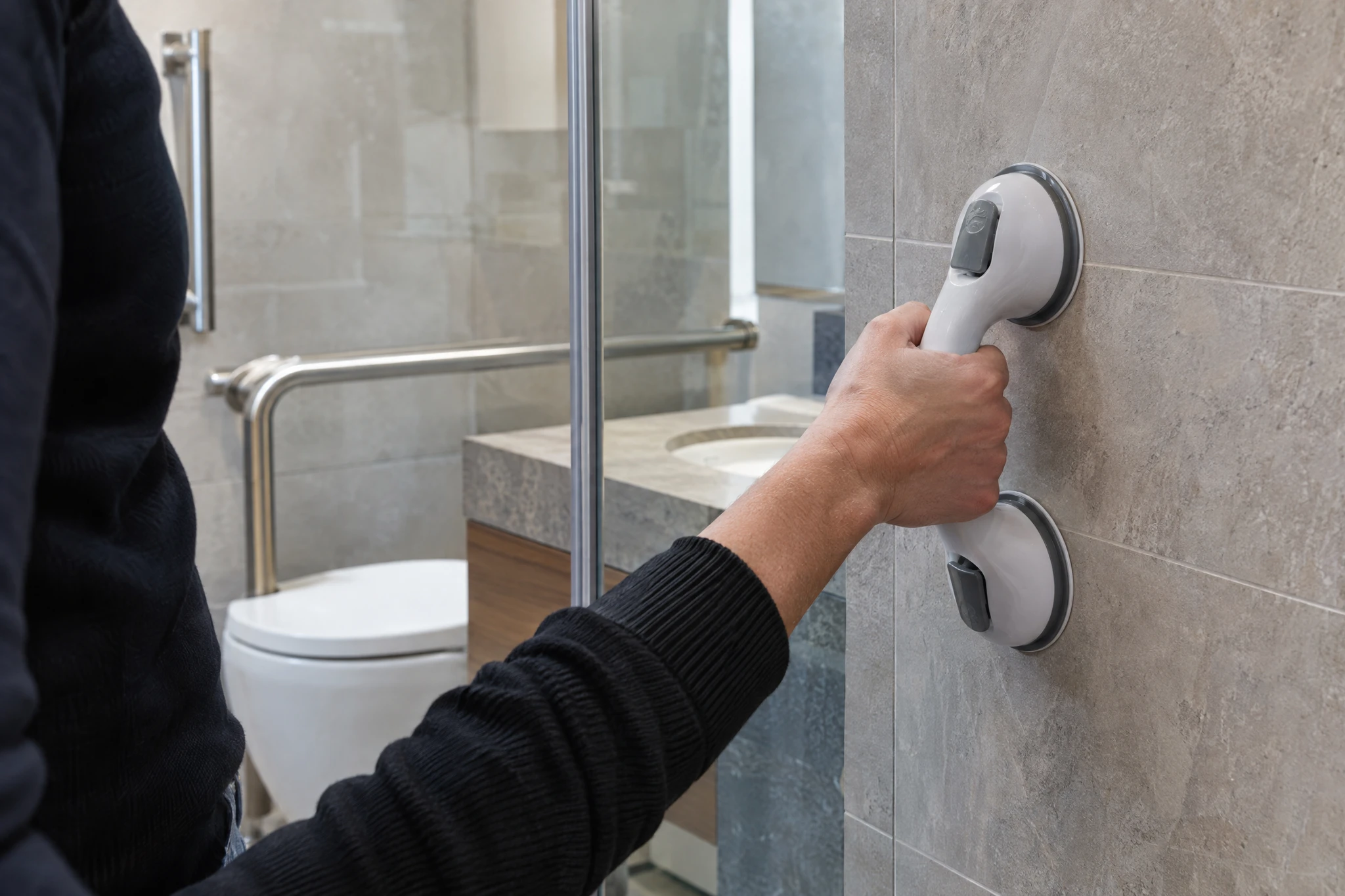
Suction grab bars are generally unsuitable for commercial washrooms in the United States. The ADA Standards require grab bars, their fasteners, mounting and supporting structure to resist a defined force (section 609.8), and a suction pad adhered to tile cannot be verified as part of a compliant structure in the way a fixed rail and its backing can. This article explains why suction rails are a poor fit for commercial projects and what to specify instead.
What the Standard Assumes About Load
The 2010 ADA Standards, published by the Department of Justice and maintained by the US Access Board, set the baseline requirements for accessible grab bars in places of public accommodation. Section 609.8 assesses the grab bar, its fasteners, its mounting and the supporting structure together under a 250 pound (1112 N) force. See the official text at https://www.access-board.gov/ada/.
This is a requirement applied to the installed assembly, not a Flanso product test result. The important point for specifiers is that the standard treats the bar and its anchoring as one system. A suction pad bonded to a smooth surface has no documented connection to the wall structure, so there is no practical way to demonstrate that the assembly meets 609.8 in a commercial setting.
Suction devices also depend on surface condition, cleanliness and re-pressurising over time. Those are assumptions a commercial washroom cannot reliably maintain across years of public use.
Liability and Maintenance Records
When a person relies on a grab bar during a transfer, the facility is effectively promising that the bar will hold. With a fixed rail specified against the standard, the evidence chain is clear: the drawing, the wall assembly, the fastener specification and the installation sign-off.
With a suction rail, that chain breaks. Questions a facility manager cannot easily answer include:
- Who checked the attachment on installation day?
- Who checks it daily, weekly or monthly thereafter?
- What written record shows it was still secure at any given moment?
- How does the assembly demonstrate compliance with 609.8?
In a dispute or an insurance review, the absence of verifiable attachment is a serious weakness. Suction rails also invite informal repositioning by staff, which puts the mounting location out of alignment with the documented layout.
What the Standard Covers: Form and Position
Beyond structural performance, the ADA Standards define the bar itself and its position. Section 609.2.1 sets the outside diameter of a circular cross-section between 1.25 and 2 inches (32 and 51 mm). Section 609.4 generally measures horizontal bar height to the top of the gripping surface, between 33 and 36 inches (840 and 915 mm) above the finish floor, with separate provisions applying to children's water closets and the lower bathtub back-wall rail.
These figures confirm the point about intended use. The Standards describe permanently positioned gripping surfaces arranged for controlled transfers, not portable accessories. Suction rails are not referenced as a means of meeting these requirements.
Note that section 610 covers seats, not grab-bar requirements, so seating provisions should not be confused with the rail provisions in 609.
What to Specify Instead
For fixed support in a US commercial washroom, the specification should address:
- A fixed grab bar with a circular gripping surface within the 609.2.1 diameter range
- A mounting location and height coordinated with the fixture layout and the applicable 609 provisions, with any exceptions identified by the project designer
- A wall assembly, blocking or reinforcement designed so the installed bar, fasteners, mounting and supporting structure can meet 609.8
- Finishing and fixing details suitable for the substrate, agreed between the project designer and a qualified installer
Refer structural and installation decisions to the project designer and the qualified installer. They hold the wall build-up drawings and can confirm how the assembly achieves the required performance.
Building the Submittal Evidence
Because compliance is judged on the installed assembly, your documentation should connect every link in the chain. A useful submittal set includes:
- The product drawing showing grip diameter, length and material
- The plan and elevation showing bar position relative to water closets or showers
- The wall section or blocking detail showing how loads reach the structure
- Manufacturer installation instructions and any model-specific technical information requested from the supplier
- Installer sign-off confirming the assembly was installed per instructions
Flanso does not publish blanket dimension sheets or hold third-party certifications to cite here. Request model-specific information for the exact rail specified so the submittal describes the product actually installed. See https://flanso.com/#contact to make an enquiry.
Project Checklist
Before finalising a grab bar specification for a US commercial washroom:
- Confirm the applicable requirements against the official ADA Standards text at https://www.access-board.gov/ada/
- Confirm which section 609 provisions apply to each fixture, and identify any exception cases
- Specify fixed rails only; remove suction rails from the schedule for public washrooms
- Coordinate the wall reinforcement detail so 609.8 performance is achievable
- Record grip diameter against the 609.2.1 range
- Record mounting height against 609.4, or the applicable exception
- Request model-specific technical information from the supplier for the submittal
- Have the qualified installer sign off the completed assembly
Fixed support is not only a compliance question. It is how a commercial washroom gives every user the same dependable handhold, shift after shift, without relying on memory or maintenance goodwill.