
Field notes / US
Commercial Grab Bars: How US Specification Differs from Residential Products
For US facility managers: why commercial grab bar specification demands more than a residential product, covering duty, wall assemblies, documentation and procurement questions.
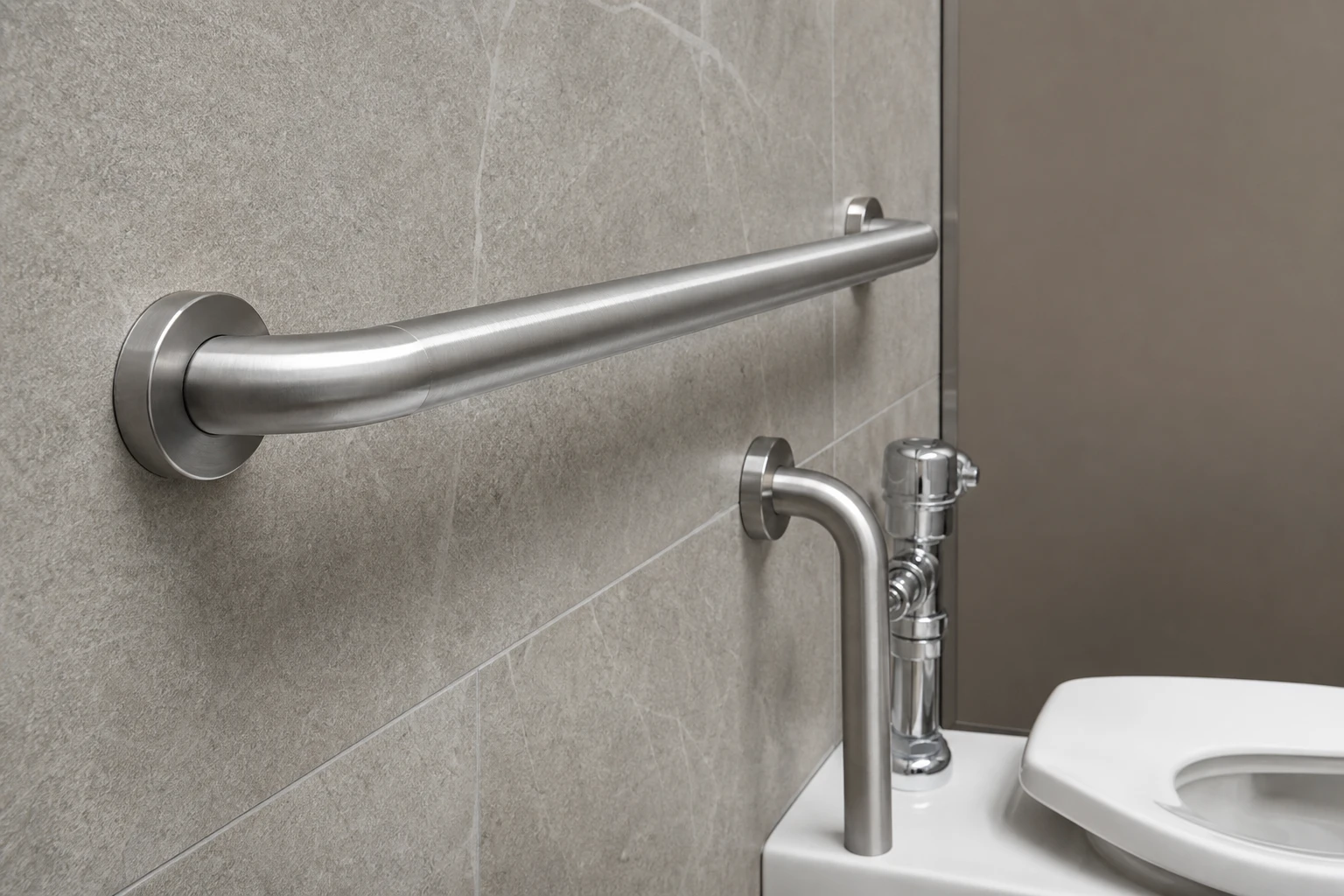
Commercial grab bar specification differs from residential work mainly in the level of documented duty expected: the applicable US accessibility requirements, the supporting wall assembly, and the paper trail that proves the installed assembly was specified with those requirements in mind. A rail that looks identical to a domestic product can fail a commercial project on documentation alone. This article outlines the differences for facility managers procuring for US commercial washrooms, under the 2010 ADA Standards for Accessible Design issued by the US Department of Justice, with the official combined text published by the US Access Board at https://www.access-board.gov/ada/.
The standard applies to the whole installed assembly
Residential buying usually focuses on the rail itself: length, diameter, finish. Commercial specification under the ADA Standards treats the grab bar as one part of a system that includes fasteners, mounting method and the supporting structure. Section 609.8 assesses the grab bar, its fasteners, mounting and supporting structure under a 250 pound (1112 N) force. That is a requirement written into the standard, not a Flanso product test result, and it means the wall behind the rail is part of the compliance question. A strong rail fixed to an inadequate wall does not satisfy the requirement.
This is the single biggest difference from residential practice, where a fixing into suitable masonry or timber is often judged informally. In commercial work, the supporting construction should be identified in the specification and coordinated by the project designer with whoever builds the wall.
Dimensional requirements are codified, not assumed
Residential products are often described with loose terms such as standard height. The ADA Standards set out specific geometric requirements instead. Section 609.2.1 requires circular grab bar outside diameter between 1.25 and 2 inches, with 32 and 51 mm given in the standard. Section 609.4 generally measures horizontal grab bar height to the top of the gripping surface, between 33 and 36 inches (840 and 915 mm) above the finish floor, with separate provisions for children's water closets and the lower bathtub back-wall rail. Those exceptions matter: applying the general height range to the wrong fixture type is a common submittal error.
Residential packaging rarely documents gripping surface diameter precisely, which is one reason a domestic product can be awkward to specify commercially. Ask manufacturers for model-specific dimension information rather than relying on catalogue descriptions.
Documentation expectations are higher
In a residential retrofit, a photo and a receipt may be the only record. In commercial procurement, the submittal package is part of the deliverable. A useful commercial grab bar enquiry or submittal should request:
- Model-specific dimension drawings showing gripping surface diameter and overall geometry
- Manufacturer installation instructions for the specific product
- Finish and material descriptions suitable for the washroom environment
- Clear statements of which standard sections the product geometry is intended to help meet, without treating those statements as proof of compliance for the installed assembly
The distinction matters. A manufacturer statement that a rail's diameter falls within the 609.2.1 range describes the product. It says nothing about the wall, the fixings or the installation quality, which together determine whether section 609.8 is met on site.
Wall assemblies deserve equal attention in the spec
Commercial washrooms often use partition systems, stud walls with linings, or tiled assemblies over substrates that differ from typical domestic construction. Because the supporting structure falls within the scope of the anchoring assessment, the grab bar specification and the wall specification should be reviewed together. Identify the substrate, the lining build-up and where reinforcement or blocking may be required before products are ordered. The project designer and a qualified installer should own these structural and installation decisions; a hardware supplier can supply product information but cannot confirm that a given wall assembly will perform.
Procurement questions for facility managers
When comparing commercial suppliers, ask questions that a residential buyer would never need to:
- Which ADA Standards sections does the product geometry relate to, and can you supply drawings to support that?
- What installation instructions exist for this model, and what do they say about wall types?
- What finish and maintenance information is available for a commercial washroom environment?
- Can documentation be issued in a submittal-ready format?
Keep the answers with the project record. If the building is later audited or refurbished, the documentation trail is often more valuable than the products themselves.
A project checklist
- Confirm the applicable standard and record that you are working to the 2010 ADA Standards, citing the official text at https://www.access-board.gov/ada/
- Identify fixture types and user group before checking height and placement provisions, and note the exceptions in 609.4
- Specify gripping surface diameter against section 609.2.1
- Define the wall assembly and coordinate backing with the project designer
- Refer structural adequacy under section 609.8 to a qualified installer and the responsible designer
- Request model-specific documentation from manufacturers, including Flanso, via https://flanso.com/#contact
- Record all decisions in the submittal file, and keep anchoring questions visible in the specification review at https://flanso.com/#anchoring
Commercial specification is not about buying a heavier-looking rail. It is about specifying a documented assembly against published requirements, with the wall, the fixing and the paperwork treated as seriously as the bar itself.