
Field notes / US
Flip-Up Grab Bar Servicing and Inspection in US Commercial Washrooms
A maintenance and inspection guide for flip-up grab bars in US commercial washrooms: swing path checks, locking mechanisms, wear points and replacement decisions, using manufacturer documents and official ADA guidance.
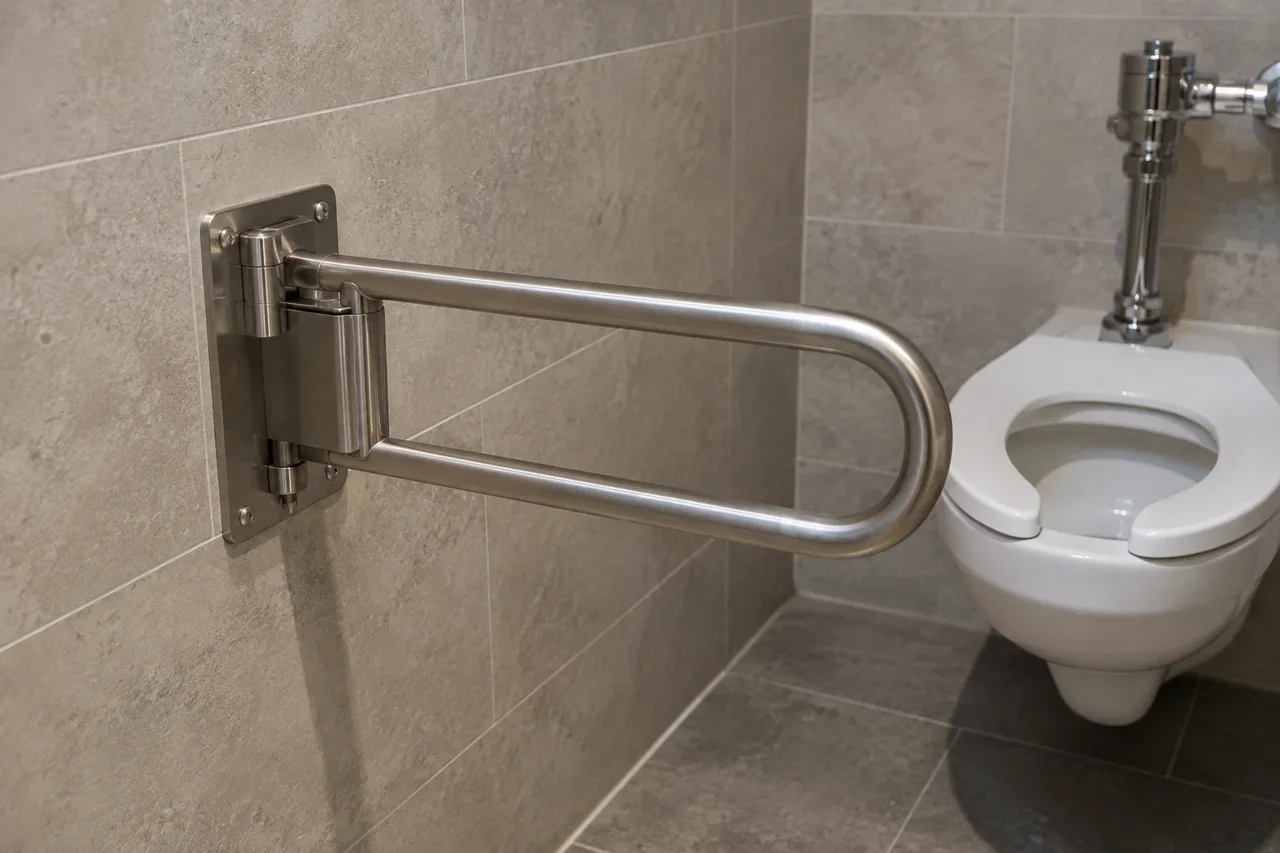
A flip-up grab bar in a US commercial washroom needs a documented servicing and inspection schedule that goes beyond what a fixed rail requires. The moving parts that make the rail convenient also introduce the main failure points: the hinge, the locking mechanism and the swing path. This article sets out how facility managers and specifiers in the United States can build that schedule using manufacturer maintenance documents and the official ADA Standards, without turning any of it into a substitute for model-specific manufacturer instructions.
The regulatory baseline in the United States
The US Department of Justice issued its ADA Standards in 2010, and the US Access Board publishes the official combined standards text at https://www.access-board.gov/ada/. Section 609 addresses grab bars generally. It is worth noting that section 610 deals with seats, not grab-bar requirements, so folding seat provisions should not be read across to flip-up rails even though the two products are often installed side by side.
Several fixed requirements matter to a maintenance programme because they define what the installed rail must still achieve after years of use. Section 609.8 assesses the grab bar, its fasteners, mounting and supporting structure under a 250 pound (1112 N) force. Section 609.2.1 sets the outside diameter of a circular gripping surface between 1.25 and 2 inches (32 and 51 mm). Section 609.4 generally measures horizontal bar height to the top of the gripping surface, between 33 and 36 inches (840 and 915 mm) above the finish floor, although separate provisions apply to children's water closets and the lower bathtub back-wall rail, so that range should not be applied to those exceptions.
These are standards requirements, not evidence about any particular product. Whether a specific Flanso flip-up rail can meet them, and under what wall conditions, must be confirmed with the manufacturer's model-specific documentation before and after installation.
Why flip-up rails need a different schedule
A fixed grab bar has no moving parts. Its inspection can focus on fasteners, surface condition and the wall behind it. A flip-up rail adds a hinge assembly, a locking or detent mechanism that holds the bar in the horizontal position, and a stored position against the wall. Each of these can degrade independently of the rail body.
The consequence is that a flip-up rail can look compliant while being functionally unsafe: the bar swings freely, fails to lock in the horizontal position, or no longer returns cleanly to the stored position. A servicing schedule for flip-up rails therefore has to test the movement and locking function as routinely as it checks fixings.
Checking the swing path
The swing path is the arc the rail travels between its stored and deployed positions. Obstructions here are both a safety and a compliance issue.
Inspect the full arc at each service visit. Look for:
- New fixtures, dispensers or fittings mounted on adjacent walls that the bar now contacts during movement.
- Doors, partitions or bins that encroach on the deployed position even if they clear the stored position.
- Finished-surface changes, such as added skirtings, panels or tile build-ups, that the bar now strikes.
- Bumping damage on the rail or the wall that indicates repeated contact.
Any obstruction found should be recorded with photographs and referred to the project designer, because resolving it may involve relocating equipment or reviewing the layout against the ADA Standards, not just adjusting the rail.
Locking mechanism and hinge checks
The locking mechanism is the component most likely to fail in service. Manufacturer documents define how each model's lock operates and what wear signs to look for, so those documents should drive the checklist rather than generic assumptions.
Typical checks, confirmed against the manufacturer's instructions, include verifying that the bar locks positively in the horizontal position, that the release operates smoothly, that the hinge has no excessive play or lateral wobble, and that any specified lubricant has been applied at the stated interval. Using an unspecified lubricant or forcing a stiff hinge can cause damage the manufacturer's documentation does not cover, so deviations should be escalated rather than improvised.
Wear points and cleaning compatibility
Wear concentrates at predictable locations: the hinge pin, the locking contact surfaces, the fixing points where load cycles loosen fasteners, and the gripping surface where finishes and knurling can wear smooth. High-traffic facilities should expect faster wear at all of these.
Cleaning agents matter too. Aggressive or incompatible cleaners can degrade the finish, and a degraded gripping surface can compromise usability. The manufacturer's cleaning guidance should be requested at purchase and attached to the inspection record so that cleaning staff and maintenance contractors work from the same document.
Replacement versus repair
Repair is reasonable where the manufacturer still supplies spare parts, the fault is isolated to a defined component such as a lock or hinge kit, and the rail body, fixings and wall condition remain sound. Replacement is the better decision when the manufacturer no longer supports the model, when wear has affected the structural components assessed under section 609.8, when the gripping surface falls outside the diameter range of section 609.2.1 through wear or damage, or when repeated repairs of the same mechanism suggest systemic wear. The decision should be documented with the reason, since replacement may also trigger a re-check of mounting height and position under section 609.4.
Building the inspection record
A usable record is simple and consistent. For each rail, keep the manufacturer's maintenance and cleaning documents on file, log each inspection date with the outcome of the swing path, locking, hinge and fixing checks, note any obstructions found and how they were referred, and record repair or replacement decisions with their justifications. When walls, fixtures or finishes change, re-verify the installed position against the ADA Standards and update the submittal file.
Project checklist
- Obtain the manufacturer's maintenance, cleaning and spare-parts documentation for each flip-up rail model at purchase.
- Set an inspection interval appropriate to traffic level and confirm it against the manufacturer's stated servicing requirements.
- At each visit, check the full swing path for obstructions introduced by new fixtures or surface changes.
- Test the locking mechanism in the horizontal position and record the result.
- Inspect hinge play, fixing tightness and gripping-surface condition.
- Log cleaning agent compatibility against the manufacturer's guidance.
- Record repair versus replacement decisions with reasons and re-check mounting position after any replacement.
- Refer structural questions, wall conditions and layout decisions to the project designer and a qualified installer.
For model-specific maintenance documentation, spare parts availability and specification information, request it through the Flanso enquiry page at https://flanso.com/#contact. Wall construction and anchoring questions can be raised via https://flanso.com/#anchoring.