
Field notes / US
Handrail or Grab Bar? Terminology for US ADA Commercial Projects
Handrails and grab bars point to different ADA sections. Know which term to use in your submittals before ordering commercial washroom fittings.
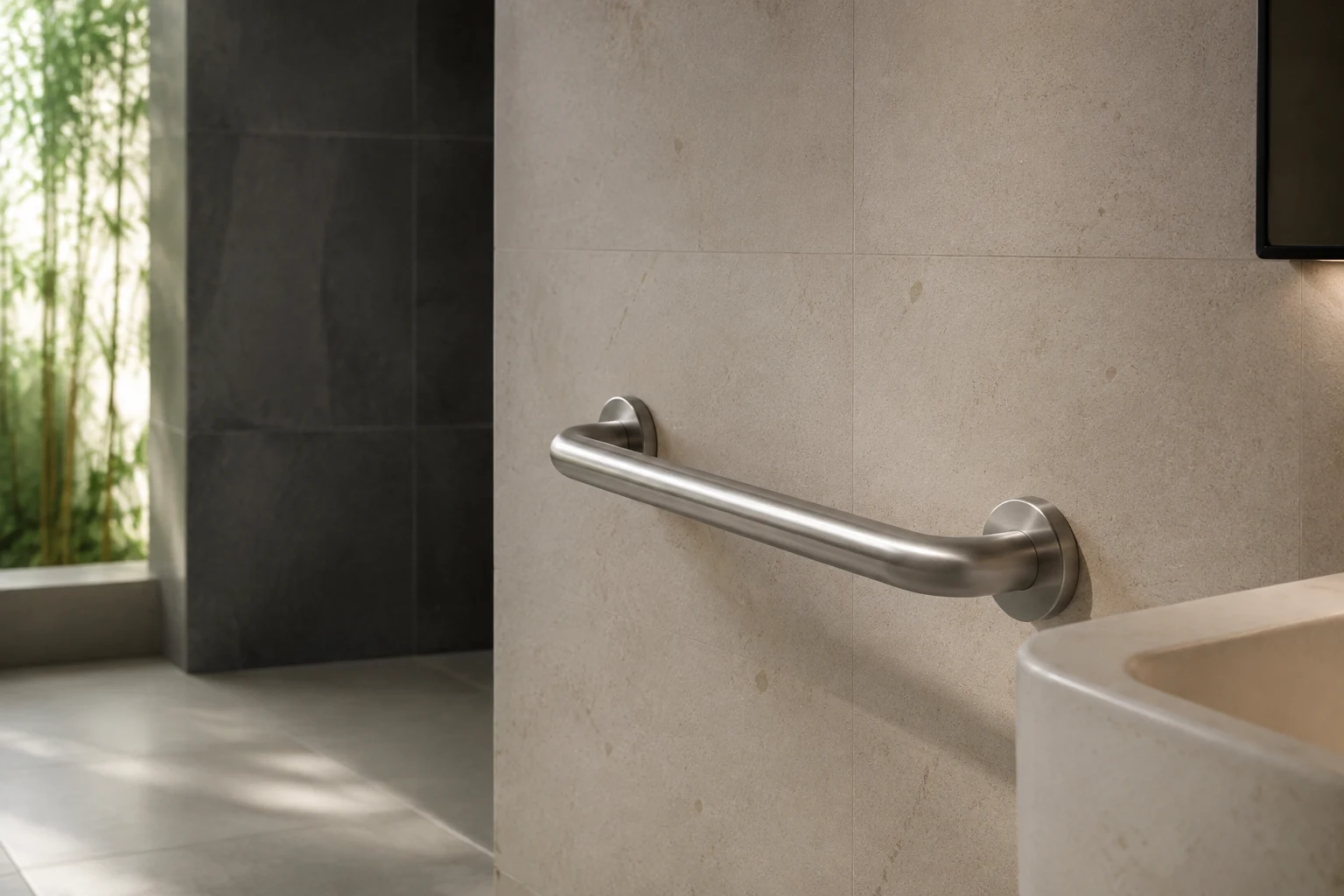
In a US commercial project, the terms are not interchangeable. Under the 2010 ADA Standards, a grab bar refers to a bar that provides support at water closets, bathtubs and showers, and the requirements sit in section 609. A handrail belongs to accessible means of travel such as ramps and stairs, and is addressed elsewhere in the standards. Writing the wrong term into a schedule sends reviewers to the wrong sections and can stall a submittal. The official combined ADA Standards text is published by the US Access Board at https://www.access-board.gov/ada/.
Why the terminology matters in submittals
Architectural schedules, product data sheets and installation drawings all travel between the designer, the contractor and the accessibility reviewer. If a washroom fitting is described as a handrail, the reviewer may check it against handrail provisions that do not apply to water closet and bathing fixtures. If a ramp or stair fitting is described as a grab bar, the reverse happens. Use each term for what the 2010 ADA Standards actually name, and cite the specific section rather than the product name as your evidence.
This distinction also changes what evidence you request from a supplier. A grab bar enquiry under section 609 concerns the bar itself, its fasteners, its mounting and the supporting structure. A handrail enquiry on a ramp or stair concerns a different set of provisions in the standards. The product names a manufacturer uses in marketing do not carry regulatory meaning; the section citations do.
Grab bars: section 609
For water closets, bathtubs and showers in US projects, the relevant requirements for the bar are gathered in section 609 of the ADA Standards. Key provisions to reference in your submittal include:
- Section 609.2.1 covers the gripping surface. A circular bar must have an outside diameter between 1.25 and 2 inches, given in the standard as 32 and 51 mm.
- Section 609.4 addresses horizontal bar height. It is generally measured to the top of the gripping surface, between 33 and 36 inches (840 and 915 mm) above the finish floor. Separate provisions apply to children's water closets and the lower bathtub back-wall rail, so this range must not be applied to those exceptions without checking the standard.
- Section 609.8 covers structural strength. The bar, its fasteners, its mounting and the supporting structure are assessed under a 250 pound (1112 N) force. This is a requirement of the standard, not a product test result from any manufacturer.
A note on a common confusion: section 610 of the ADA Standards addresses seats, not grab-bar requirements. If a project pairs bars with a shower or bathtub seat, cite section 610 for the seat and section 609 for the bars.
What each requirement applies to
Section 609.8 is worth reading carefully because it is often quoted loosely. It does not test a bar in isolation. The force requirement applies to the whole assembly: the bar, the fasteners, the mounting and the wall behind it. A compliant-looking bar fixed to an inadequate wall assembly does not satisfy the requirement. This is why the wall build-up belongs in the same specification review as the fitting, and why structural and installation decisions should be confirmed by the project designer and a qualified installer rather than resolved from a product catalogue.
Handrails in the same building
If your project also includes ramps, stairs or other elements where the standards call for handrails, those fittings follow the handrail provisions in the ADA Standards, not section 609. Keep the two scopes separate in your schedules. A wall-mounted support bar next to a water closet is a grab bar. A rail along a ramp or stair is a handrail. Where both appear in one washroom or circulation area, label them separately on drawings so reviewers can check each against the correct sections.
Building the terminology into your enquiry
When you approach a supplier, state the jurisdiction and the sections you are designing to. A useful grab bar enquiry for a US commercial project typically states:
- The applicable sections, for example 609.2.1 for gripping surface, 609.4 for height, 609.8 for structural strength.
- The fixture type and location, so the correct placement provisions in the standard are checked rather than assumed.
- The wall construction at each bar location, so the designer and installer can assess the assembly under 609.8.
- The finish and material expectations for the commercial washroom environment.
Flanso supplies stainless steel grab bars for commercial washrooms. For model-specific information on dimensions, finishes and documentation, request it directly through https://flanso.com/#contact. Do not assume a product description alone settles compliance; the installed assembly and the cited sections are what reviewers assess.
Project checklist
Before ordering, confirm the following:
- Jurisdiction and that the 2010 ADA Standards apply, using the official Access Board text at https://www.access-board.gov/ada/.
- Each fitting is named correctly in schedules: grab bar for water closet, bathtub and shower locations; handrail for ramps and stairs.
- Section citations attached per location: 609.2.1, 609.4, 609.8 as relevant, and section 610 for seats separately.
- Height range 33 to 36 inches (840 and 915 mm) applied only where 609.4 permits, with exceptions checked against the standard.
- Wall construction and backing documented at every bar location for the 609.8 assembly assessment.
- Structural and installation decisions assigned to the project designer and a qualified installer.
- Model-specific product information requested from the supplier rather than assumed.
Clear terminology is the cheapest risk reduction on a washroom package. Name the sections, not the marketing terms, and route every structural question to the people signing off the design and installation. For anchoring and wall assembly background, see https://flanso.com/#anchoring.