
Field notes / FR
Reading 'barre d'appui handicapé' claims: what French specifiers should ask suppliers to evidence
How to treat 'handicapé' labelling in French support bar supplier documentation, which official PMR sources to cite, and how to structure an evidence request in a tender.
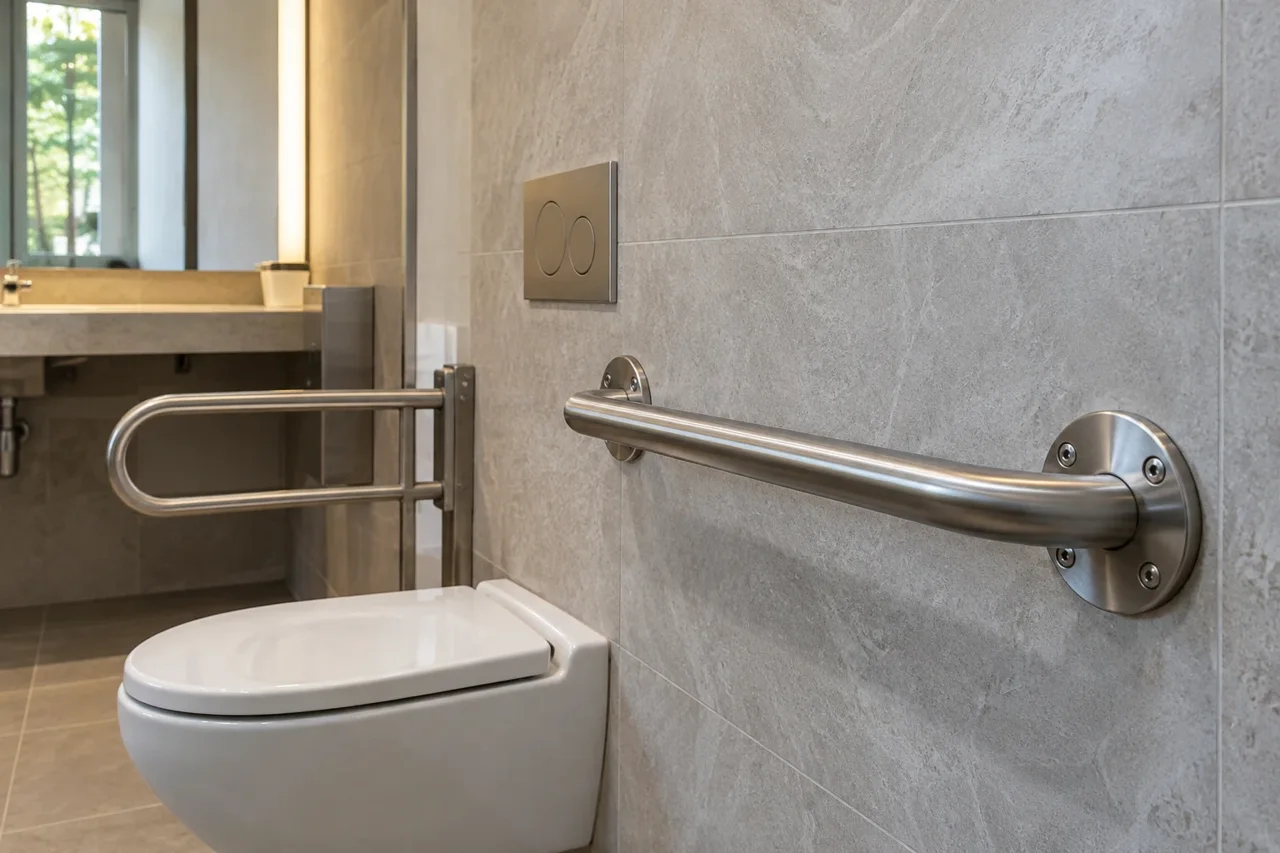
A supplier describing a barre d'appui as suitable for 'handicapé' or PMR use is making a claim, not supplying proof. In a French commercial washroom project, that claim must be backed by model-specific documentation, and the applicable accessibility requirements are determined by the project itself, not by a product label. This article explains how to read such claims, which official French sources to reference, and how to structure an evidence request in your tender documents.
Why 'handicapé' labelling is not enough on its own
The term 'barre d'appui handicapé' appears widely in supplier catalogues and marketplace listings. It signals intended use, but it does not tell you which requirements the product meets, whether any testing has been carried out, or whether the rail suits your wall construction and layout. In France, accessibility obligations for establishments receiving the public (ERP) cover public sanitary facilities, and the procedures differ between new builds and existing premises. A project must establish its own applicable requirements, and a support bar is only one element of the overall accessible layout. The official service-public guidance for businesses sets out this framing: see https://entreprendre.service-public.gouv.fr/vosdroits/F32873.
This matters for procurement because the compliance burden sits with the project, not with a product word. A rail described as 'handicapé' in one catalogue may have entirely different documentation behind it from a similarly described rail in another. Your tender should therefore convert vague terminology into specific, verifiable requests.
Which official French sources to reference
When writing an enquiry or tender line for support bars in France, cite official guidance rather than supplier marketing language. The starting point is the service-public page for ERP operators, which explains that accessibility requirements apply to sanitary facilities and that the route depends on whether the premises are new or existing: https://entreprendre.service-public.gouv.fr/vosdroits/F32873.
Use this source to anchor two points in your documentation:
- The project, not the supplier, determines which accessibility requirements apply, based on the building's status and the works programme.
- The support bar is part of a wider accessible sanitary layout, so product evidence must be read alongside the overall design, not instead of it.
Referencing official guidance in your tender also discourages suppliers from answering with generic accessibility wording. Ask them to respond against your stated project context.
What supplier documentation should actually contain
An evidence request is useful only if it is specific. For each proposed barre d'appui, ask the supplier to provide:
- The exact model reference and product data sheet, so the claim can be tied to a defined product rather than a product family.
- Manufacturer installation instructions, so the qualified installer can assess suitability for the wall construction on site.
- Any material, finish and cleaning-compatibility information relevant to a high-traffic commercial washroom.
- If the supplier asserts conformance with a standard or test, the precise identifier of that standard or test and the document that supports the assertion. Do not accept a logo or the word 'handicapé' as evidence.
- Availability of spare parts or fixing information where relevant to long-term servicing.
Note what this list does not do. It does not assume that any product is certified or tested. If a supplier states a product meets a given requirement, that statement belongs in their submittal, where it can be checked by the project team.
Structuring the evidence request in the tender
A clear structure makes supplier responses comparable and auditable. A practical format for the support bar package:
- State the project context: ERP status, whether the works concern new or existing premises, and that applicable requirements are being established by the project team per official guidance.
- Define the deliverable: for each model offered, a complete submittal containing the data sheet, installation instructions, and any supporting documents for claims made.
- Require traceability: every claim in the supplier's response must point to a specific document or be withdrawn.
- Separate responsibilities: the project designer confirms placement and coordination with the wider accessible layout; the qualified installer confirms anchoring suitability; the supplier evidences the product itself.
This structure keeps the tender focused on evidence rather than adjectives. Suppliers who respond with terminology alone can be identified quickly.
Roles: designer, installer and supplier
Support bar decisions in a French ERP washroom involve three distinct parties, and your documentation should reflect that. The project designer establishes which accessibility requirements apply to the premises and how the rail fits into the accessible sanitary layout, following the framework described at https://entreprendre.service-public.gouv.ru/vosdroits/F32873. The qualified installer assesses whether the wall construction can anchor the specified rail as the manufacturer instructs; structural and installation decisions rest with them. The supplier's role is to document the product accurately. Flanso does not publish project compliance advice; for model-specific information, including product documentation for the rails you are evaluating, request it directly via https://flanso.com/#contact, and refer anchoring questions to https://flanso.com/#anchoring and to your installer.
Project checklist
- Confirm the building's ERP status and whether the works concern new or existing premises, and record which requirements the project team has established as applicable.
- Cite official French guidance (https://entreprendre.service-public.gouv.fr/vosdroits/F32873) in the tender rather than supplier wording.
- Treat 'handicapé' or PMR labelling as a claim to be evidenced, not a specification.
- Request per-model data sheets, installation instructions and supporting documents for any stated conformance.
- Require traceability for every accessibility claim in supplier responses.
- Assign placement to the project designer and anchoring suitability to the qualified installer.
- File all submittals against the project's accessibility record so they can be reviewed as part of the overall layout.
Photographs in catalogues or listings illustrate products; they do not demonstrate that an installed arrangement meets a project's requirements. Only the documented combination of correct project requirements, evidenced products and competent installation supports the finished result.