
Field notes / FR
Inspecting and Servicing Shower Support Bars in French Commercial and Care Facilities
A practical maintenance and inspection guide for barres d'appui in French commercial and care shower rooms: fitting checks, surface condition, cleaning compatibility, records and replacement decisions.
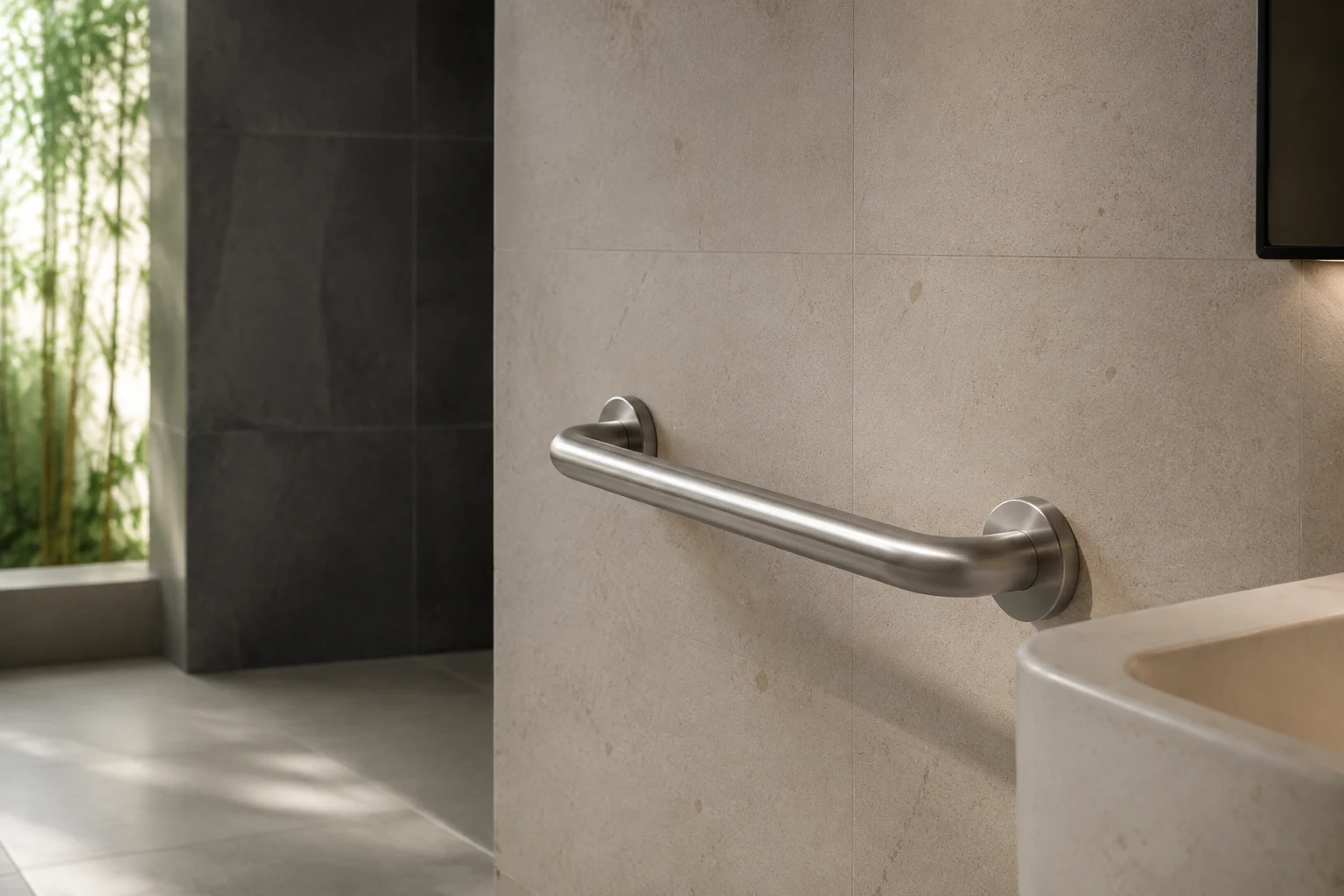
A shower support bar (barre d'appui pour douche) in a French commercial or care setting stays safe only if it is inspected and serviced on a defined schedule. Fittings can loosen, surfaces can degrade and cleaning agents can attack finishes. This guide sets out what a facility team in France should check, what to record and when to replace a rail rather than repair it, using the manufacturer's documentation as the reference. Placement and structural questions belong to the project designer; fixing work belongs to a qualified installer.
The French context: ERP obligations and the whole layout
Establishments receiving the public (établissements recevant du public, ERP) in France are subject to accessibility requirements that cover sanitary facilities, including showers. The procedures differ between new builds and existing premises, so each project must establish its own applicable requirements. The official guidance is published on Service-Public Entreprendre: https://entreprendre.service-public.gouv.fr/vosdroits/F32873.
Two points matter for maintenance planning. First, a support bar is only one element of an accessible shower layout; keeping the bar serviceable does not by itself keep the shower compliant. Second, when other fittings, wall finishes or floor surfaces change during a refurbishment, the layout should be re-reviewed by the project designer, not just the bar itself.
Building an inspection routine from the manufacturer's documentation
The manufacturer's installation and maintenance instructions are the starting point for any inspection schedule. These documents should state what the fixings are, which cleaning agents and methods are permitted, and any torque or re-tightening expectations. If this information is missing for a model already in service, request model-specific documentation from the supplier before defining the routine. Flanso can supply model-specific information on request; do not assume a generic schedule fits every rail.
Use the documentation to fix three things in your maintenance plan:
- The inspection interval, adjusted for traffic: a care home shower used many times a day needs more frequent checks than a low-use staff shower.
- The permitted cleaning products and methods, so that housekeeping does not void the manufacturer's expectations.
- The described condition of fixings and surfaces when new, so deviations are easy to spot.
What to check at each inspection
A shower bar lives in a wet, humid zone subject to thermal swings and aggressive cleaning. Checks should cover:
- Fittings and fixings. Look for looseness, rotation of the tube in its brackets, and any movement under hand pressure. Any perceptible movement should be treated as a defect and escalated immediately, because a bar that shifts under load can fail a user's expectations mid-transfer.
- Surface condition. Check for scratches, pitting, chipped coating, rust bloom at joints, and worn grip surfaces. Surface damage is both a hygiene risk and a comfort issue for users relying on the rail.
- Wall condition around the bar. Cracked tiles, soft plaster or water staining around the fixings can indicate that the substrate, not the bar, is the problem. Refer substrate findings to the project designer.
- Cleaning compatibility. Confirm that the products housekeeping actually uses match the manufacturer's permitted list. Disinfectants and descaling agents can degrade finishes and grips over time.
Do not re-tighten or modify fixings beyond what the manufacturer's instructions allow. Repair work on fixings belongs to a qualified installer.
Keeping maintenance records
For French ERP settings, maintenance records are part of demonstrating that the facility is kept in the condition assessed for accessibility. For each bar, keep a simple file:
- Model reference and the manufacturer's documentation received at purchase.
- Inspection date, inspector, findings and any action taken.
- Cleaning products approved for the finish, as stated by the manufacturer.
- Dates and details of any repair or replacement, and who carried it out.
A consistent record makes it easy to show trends: a bar that is repeatedly loosening is telling you the installation or the substrate needs review, not another re-tightening.
When to replace rather than repair
Replacement, not repair, is generally the right call when:
- The fixings cannot be restored to the manufacturer's described condition, or the wall substrate around them is compromised.
- The tube, grip or coating is damaged, pitted or corroded. Cosmetic patching on a load-bearing support element is not appropriate.
- The model is no longer supported by the manufacturer with parts or documentation, so its condition cannot be verified.
- Refurbishment changes the wall construction, finishes or shower layout; the project designer should re-specify rather than reuse.
When replacing, treat it as a new installation: hand the qualified installer the manufacturer's instructions and the wall construction records, and file the new documentation in the maintenance record.
Checklist for facility teams
- [ ] Obtain the manufacturer's installation and maintenance documentation for every shower support bar in service.
- [ ] Define inspection intervals per model and per usage level.
- [ ] Check fixings for looseness, tube rotation and movement under hand pressure at each inspection.
- [ ] Inspect surfaces for damage, corrosion and grip wear.
- [ ] Verify housekeeping uses only manufacturer-approved cleaning products.
- [ ] Record every inspection, defect and action in a per-bar file.
- [ ] Escalate recurring looseness or wall damage to the project designer.
- [ ] Replace rather than repair when condition cannot be restored to the manufacturer's description.
- [ ] Re-review the accessible shower layout with the project designer after any refurbishment, citing https://entreprendre.service-public.gouv.fr/vosdroits/F32873.
For model-specific documentation, finishes or replacement enquiries, contact Flanso: https://flanso.com/#contact. General background on support bar anchoring responsibilities is available at https://flanso.com/#anchoring.