
Field notes / FR
Barre de relèvement : clarifying the term in French PMR washroom documentation
What 'barre de relèvement' means in French supplier literature, how it relates to 'barre d'appui rabattable', and what load and locking evidence to request for PMR projects.
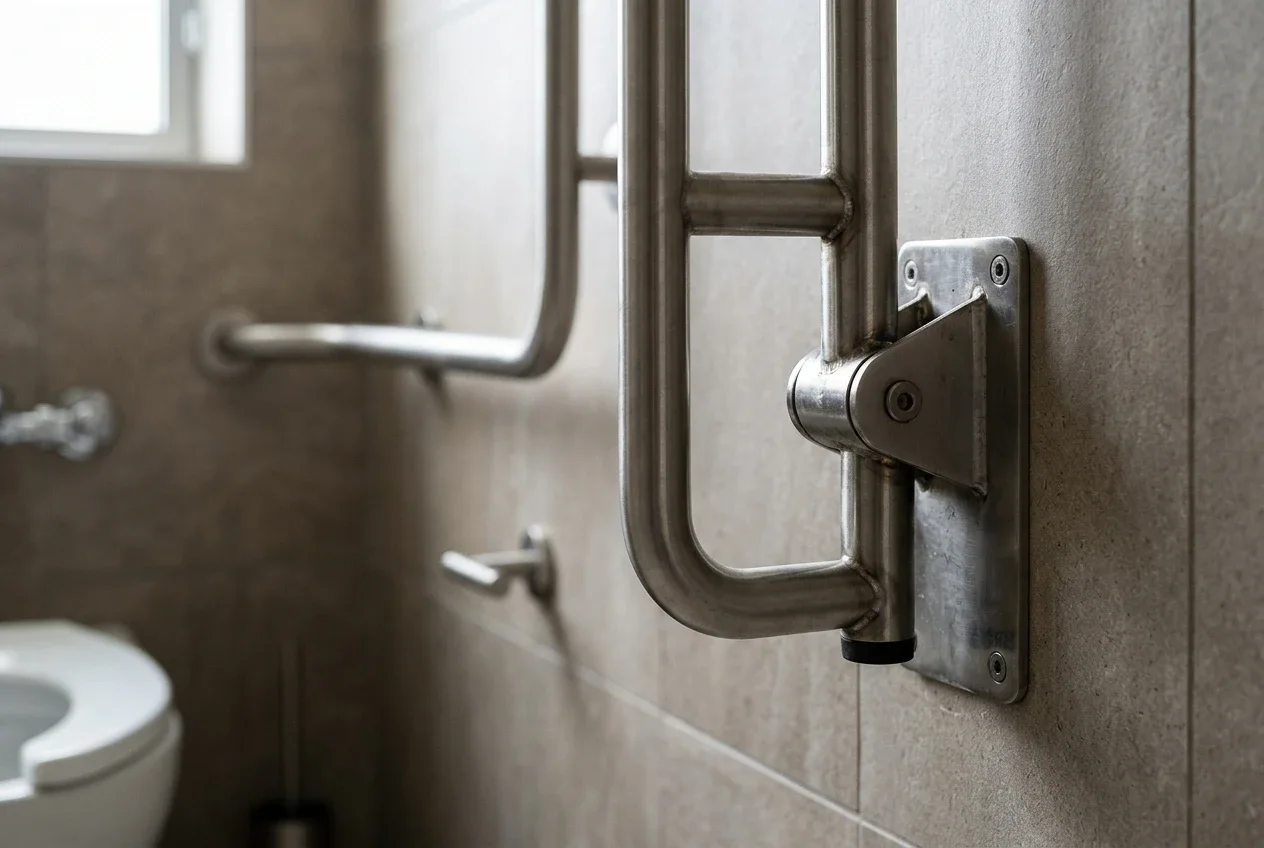
In French washroom documentation, a 'barre de relèvement' generally refers to a hinged support rail that can be lifted or folded away when not in use. It is widely used as another name for a 'barre d'appui rabattable'. The two terms describe the same product category in most supplier literature, but wording varies between manufacturers, so a specifier should never rely on the label alone. The product description, not the name, tells you whether a rail locks in position, how it is intended to be fixed, and what the manufacturer states about its use.
This article is about France. Requirements for establishments receiving the public (ERP) differ between new and existing premises, and a support bar is only one element of an overall accessible layout. The official French guidance for ERP accessibility obligations, including sanitary facilities, is published on the service-public.fr business portal: https://entreprendre.service-public.gouv.fr/vosdroits/F32873. Your project designer must establish which requirements apply to your specific building.
Why terminology matters at tender stage
Ambiguous naming creates avoidable risk in a tender. If one supplier lists a 'barre de relèvement' and another a 'barre d'appui rabattable', the products may or may not be equivalent. A rail described as foldable could be fixed, hinged without a locking mechanism, or hinged with a lock. Each of these serves a different purpose in an accessible WC or shower zone.
Ask suppliers to confirm in writing what the term means in their catalogue: whether the rail is hinged, whether it holds a raised position, whether it locks down in the horizontal position, and what mounting information they provide. Requesting this clarification per product model keeps comparisons valid across bids.
Hinged rail types for WC and shower zones
In French PMR documentation, hinged rails typically appear in two zones:
- WC zone. A hinged rail mounted beside the WC can be lowered to give support during transfer and raised to clear the space for a wheelchair user or for cleaning. Locking in the lowered position is a function to confirm with the manufacturer, not to assume.
- Shower zone. Fixed horizontal rails are common in showers, but hinged rails may be specified where the rail must not obstruct circulation or an adjoining fixture when the shower is not in use. Again, the product description should state the hinge behaviour and any locking function.
A fixed 'barre d'appui' remains a separate product category: always horizontal, never movable. Keep the distinction explicit in your specification so that pricing and submittals match the intended item.
What load and locking evidence to request
Do not accept a product name as evidence of performance. Request model-specific written information from the supplier or manufacturer, such as:
- A description of the hinge mechanism and whether the rail locks in the horizontal position, and, if so, how the lock operates.
- Any load-related information the manufacturer publishes for the specific model, together with the mounting conditions that information assumes.
- Wall construction prerequisites: what the manufacturer states about the substrate the rail is intended to be fixed to, and any limits on wall types.
- Cleaning and maintenance guidance for the finish and the hinge or locking mechanism.
- Model references, finishes and dimensions as stated in current manufacturer literature.
Whether a given rail satisfies the requirements of a particular PMR project is a decision for the project designer against the applicable regulations. Standards or product claims quoted in supplier literature are not proof that a Flanso product has been tested or certified. Ask Flanso for model-specific information for any product under consideration.
Coordinating with anchoring and wall construction
A hinged rail only performs as described if it is fixed to a substrate suited to it. Wall construction records, substrate assessment and the choice of fixings belong to the project designer and the qualified installer, not to the product catalogue. Flanso provides general context on anchoring considerations at https://flanso.com/#anchoring, but structural decisions must be confirmed by the qualified professionals on the project.
Coordinate the rail scope with other trades early. Electrical, plumbing and tiling sequences all affect when rails can be installed and what the finished wall will be when they are.
Placing the rail in the wider accessible layout
The official French guidance on ERP accessibility confirms that sanitary facilities fall within the scope of accessibility requirements for establishments receiving the public, and that procedures differ for new and existing premises (https://entreprendre.service-public.gouv.fr/vosdroits/F32873). A support rail is only part of that layout: transfer space, sanitary appliance positions, circulation and other fittings all interact. The project designer determines the applicable requirements for the building and documents how the chosen products fit them. An illustrative product photograph never proves that an installed layout complies.
Project checklist
- Confirm with the project designer which PMR requirements apply to your building, new or existing.
- Ask each supplier to define in writing what 'barre de relèvement' means for the specific model quoted.
- Confirm hinge behaviour: raised position, lowered position, and whether a locking mechanism is present.
- Request model-specific load-related information and the mounting conditions it assumes.
- Request manufacturer wall construction prerequisites and hand them to the qualified installer.
- Request cleaning and maintenance documentation for the finish and moving parts.
- Record model references, finishes and dimensions from current manufacturer literature in the submittal file.
- Do not treat standards references in brochures as certification or test evidence for a specific product.
- File the clarification correspondence with the tender record so comparisons remain traceable.
For model-specific product information for a French PMR project, send a project enquiry via https://flanso.com/#contact.