
Field notes / UK
Choosing Materials and Finishes for Commercial Bathroom Grab Rails in England
A specifier's guide to grab rail materials, finishes, grip and cleaning regimes for England commercial washrooms, plus the maintenance information to collect at specification.
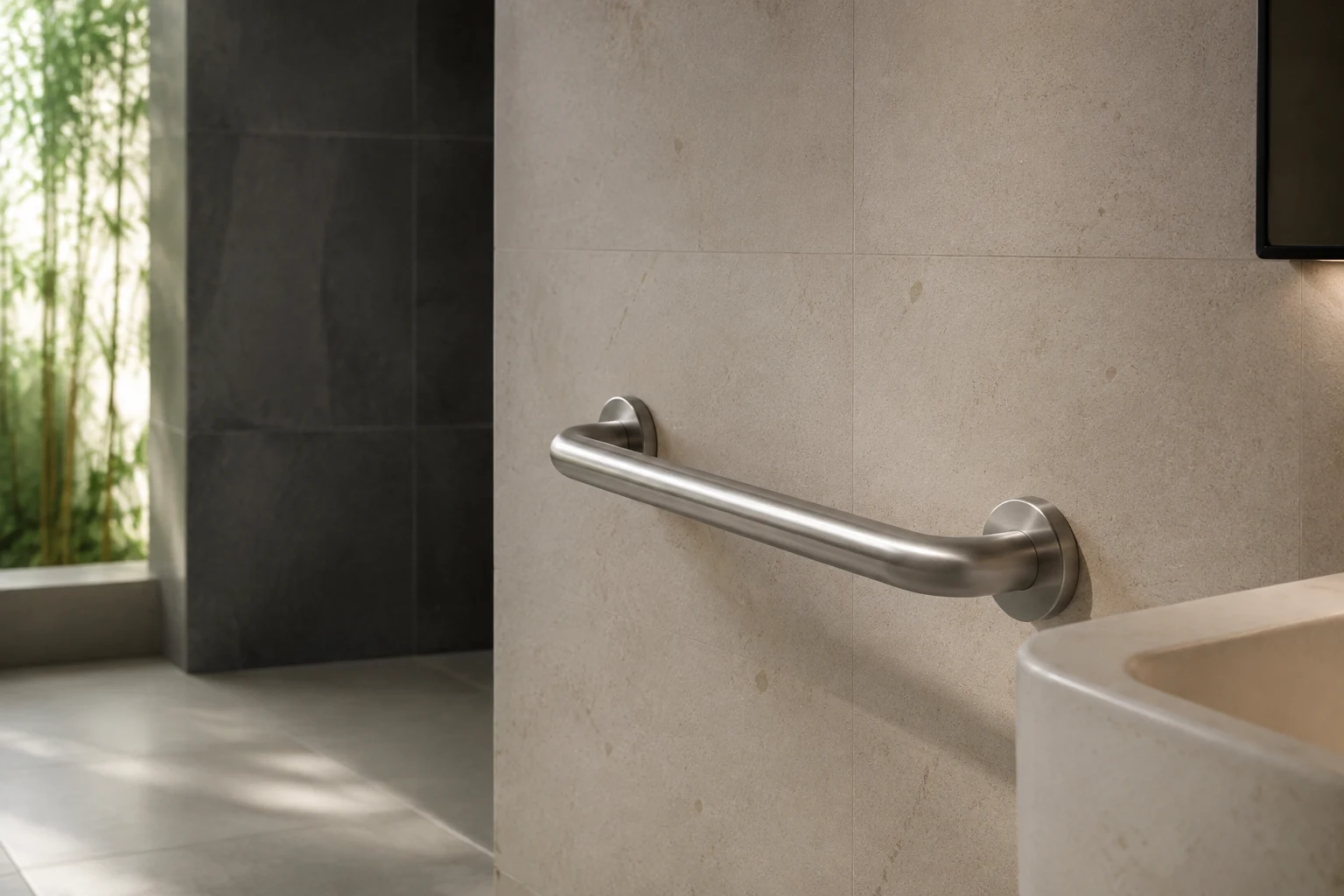
For commercial washroom projects in England, the best grab rail material and finish is the one that matches the cleaning regime, user profile and duty of the specific sector, then is documented with model-specific manufacturer information. There is no single finish that suits every setting, and official guidance such as Approved Document M sets accessible layout expectations for building work rather than certifying individual products. This article compares common material and finish options across sectors and lists what maintenance information to collect at specification stage.
Start with the guidance, then the material
In England, accessible sanitary accommodation in new building work and material alterations is typically planned against Approved Document M, which is statutory guidance covering buildings other than dwellings as a separate volume. It is not a universal UK or international product certification, and citing it does not prove that any specific rail is compliant. You can read the official document on GOV.UK at https://www.gov.uk/government/publications/access-to-and-use-of-buildings-approved-document-m.
Use the guidance to frame placement and provision, then move to product-level decisions: material, finish, grip quality and cleaning compatibility. Structural and installation decisions should be referred to the project designer and a qualified installer, since wall construction and fixings determine what a rail can safely support in practice.
Common materials for commercial grab rails
Most commercial bathroom grab rails fall into a few material families. Each suits different sectors and cleaning regimes.
- Stainless steel: A common choice for high-duty public and commercial washrooms. It tolerates frequent cleaning and heavy use, and brushed or satin finishes tend to show handling less than polished surfaces.
- Powder-coated steel or aluminium: Often used where colour contrast with the wall is wanted, for example in care or healthcare settings. Coating condition should be reviewed during maintenance, since chips or wear can affect both appearance and corrosion resistance.
- Nylon or polymer-sleeved rails: Frequently specified in care homes, hospitals and assisted-living settings because the sleeve can feel warmer to the touch and may offer a different grip character than bare metal.
- Plated or polished finishes: More common in hotel and premium leisure projects where appearance leads. Expect a higher cleaning burden to keep them presentable, and check cleaning-agent compatibility with the manufacturer.
The right answer depends on duty. A rail in a stadium washroom faces different usage and cleaning intensity than one in a care home en-suite, even where both reference the same official guidance.
Grip and contrast across sectors
Grip is not only about diameter or texture. It is about how the rail performs for the least steady user in that setting.
- Care and assisted-living settings: Users may have reduced hand strength or dexterity. Warmer polymer sleeves and finishes that provide a secure hold with wet or dry hands are often prioritised, and colour contrast against the wall helps users with visual impairment locate the rail.
- Healthcare settings: Cleaning regimes are typically intensive and may involve specific disinfectants. Confirm with the manufacturer that the finish and sleeve material tolerate the cleaning agents used on site.
- Public and leisure buildings: Duty and vandal-resistance matter as much as grip. Metal finishes that resist scratching and show less soiling reduce lifecycle cost.
- Offices and workplaces: A balance of appearance and duty. Brushed stainless remains common, with colour contrast considered where accessibility assessments call for it.
Do not assume grip quality from a finish name alone. Request model-specific product information from the supplier rather than relying on generic claims.
Matching finish to cleaning regime
Cleaning is where finishes succeed or fail in commercial settings. At specification, establish:
- Which cleaning agents and disinfectants the facility will use, and their frequency.
- Whether the finish manufacturer confirms compatibility with those agents.
- How abrasive cleaning methods affect the finish over time.
- Whether the rail construction traps dirt at joints, fixings or sleeve ends, and how easily it can be cleaned around.
A finish that is easy to clean but incompatible with the facility's disinfectants will degrade faster than expected, so this check belongs at tender stage, not after installation.
Maintenance information to collect at specification
Collect the following from suppliers before award, and file it with the O&M documentation for the building operator:
- Model-specific product data, including material and finish descriptions, so the schedule matches what is supplied.
- Manufacturer guidance on cleaning agents and cleaning frequency for each finish specified.
- Any stated inspection or maintenance intervals, and what to inspect (fixings, coating condition, sleeve integrity).
- How to obtain replacement parts, such as sleeves or fixings, for long-term upkeep.
- Contact details for technical queries during the defects period and beyond.
Never rely on the Approved Document M reference itself as product evidence. It is guidance for building work, not a test report or certification, so the documentation for the specific model must come from the manufacturer on request.
Project checklist
Before finalising the grab rail schedule:
- Confirm the project references the current Approved Document M volume for buildings other than dwellings on GOV.UK (https://www.gov.uk/government/publications/access-to-and-use-of-buildings-approved-document-m).
- Classify each room type by sector and duty: care, healthcare, public, leisure, office.
- Match material and finish to the cleaning agents and frequency in use at each facility.
- Consider grip and colour contrast needs for the user profile in each setting.
- Request model-specific product, cleaning and maintenance information from suppliers.
- Refer wall construction, fixings and load path questions to the project designer and a qualified installer (see also https://flanso.com/#anchoring).
- File cleaning and maintenance guidance with the handover documentation for the building operator.
For model-specific finish, material and maintenance information for a planned project, submit a project enquiry at https://flanso.com/#contact. Note that any illustrative photos in supplier literature show product appearance only and do not prove installation compliance on your project.