
Field notes / UK
Doc M Washrooms in England: Guidance, Packs and Product Claims Explained
What 'Doc M' actually means for a non-domestic washroom project in England, how Approved Document M differs from product certification, and how to structure a compliant enquiry.
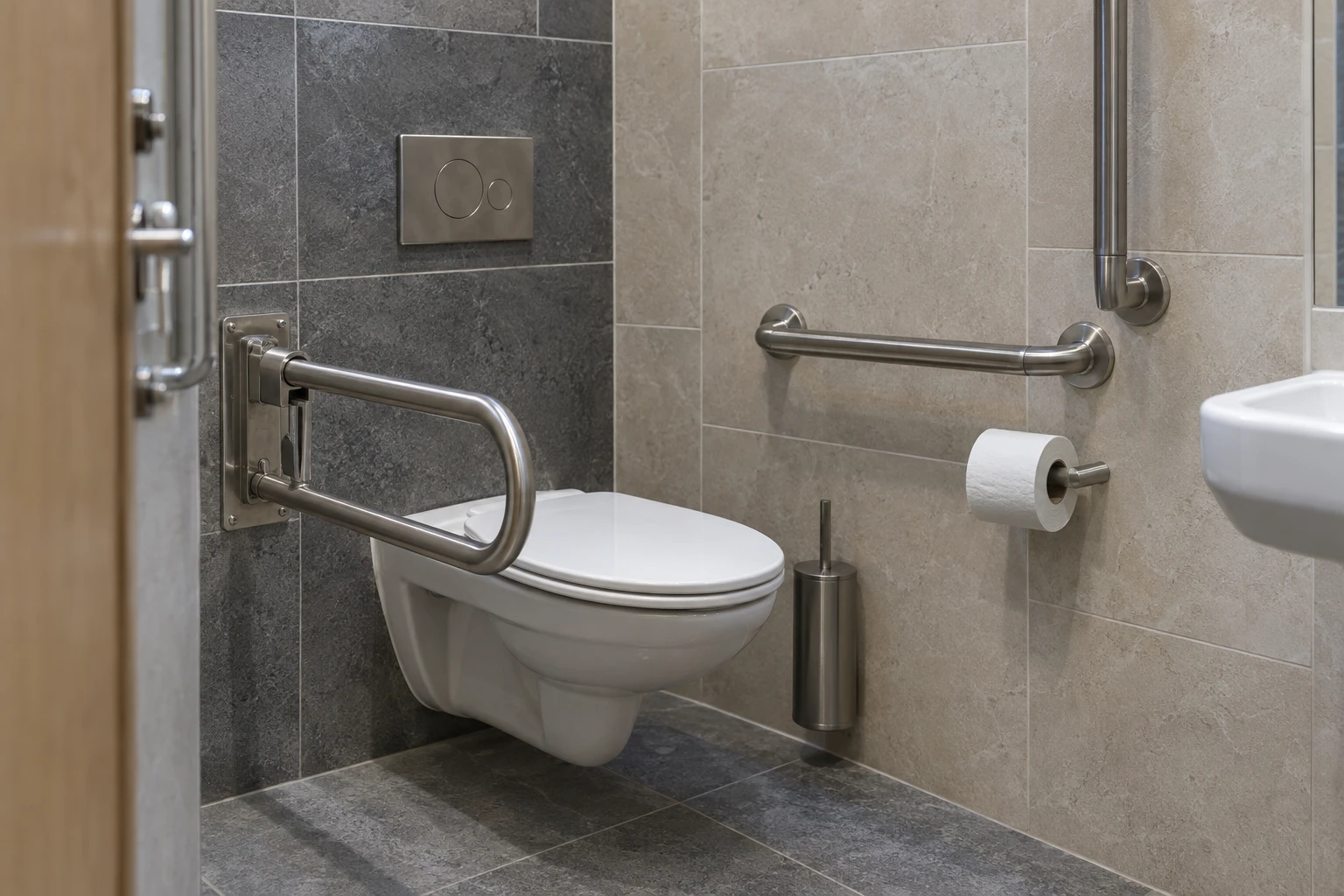
Doc M is short for Approved Document M, the statutory guidance supporting the Building Regulations in England. It is guidance on how to meet access requirements in building work, not a product certification, and it does not apply across the whole UK in a single form. For a non-domestic washroom project, the practical question is not whether a product 'is Doc M' but whether the installed arrangement meets the guidance for your building type, and who verifies that.
What Approved Document M actually is
Approved Document M is published by the UK government and gives practical ways of complying with the access requirements for building work in England. It is issued in separate volumes: one for dwellings and one for buildings other than dwellings. For a commercial, office, retail, leisure or public washroom, the relevant volume is the one covering buildings other than dwellings.
Three points matter for specifiers:
- It is guidance. There may be other ways of demonstrating compliance with the underlying Building Regulations requirements, but any alternative approach should be agreed through the project designer and, where relevant, the building control body.
- It applies to England. Scotland, Wales and Northern Ireland publish their own building standards. If your project sits outside England, this article is not the reference you need.
- It is not a universal certification. The document does not certify products, and a product description claiming to 'be Doc M' is a marketing claim unless supported by specific, verifiable evidence.
You can read the current guidance directly at https://www.gov.uk/government/publications/access-to-and-use-of-buildings-approved-document-m.
Guidance versus the 'Doc M pack'
In trade vocabulary, a 'Doc M pack' usually means a coordinated set of sanitaryware and accessories intended to make it easier to build a washroom in line with the guidance: typically a WC, basin and support fittings supplied together. The existence of such packs causes frequent confusion at tender stage.
The distinction to hold onto is this: Approved Document M is the official guidance document, while a 'Doc M pack' is a product bundle assembled by manufacturers or suppliers. Buying a bundle does not by itself demonstrate compliance. Compliance is assessed against the installed arrangement, in the context of your building, by the people responsible for the project.
That means the useful questions about a pack are not 'is it Doc M approved?' but:
- Which elements of the guidance does each component help address, and which remain the responsibility of the layout, wall construction and installation?
- What documentation does the supplier provide per component: drawings, dimensions, fixing information and material details?
- Does the bundle match the actual room design, or does it force compromises in layout that the project team then has to resolve?
Where responsibility sits in a washroom project
Grab bars and support rails illustrate the guidance-versus-product distinction well. A rail can be dimensionally appropriate, yet fail in practice because of the wall it is fixed to, the substrate behind the finish, or the quality of installation.
For this reason:
- The project designer owns the layout and the compliance strategy against current guidance.
- The qualified installer owns the selection of a fixing system appropriate to the actual wall assembly, following manufacturer instructions.
- The manufacturer or supplier can supply model-specific product information, but that information is not proof that an installed assembly performs as required.
Structural and installation decisions should always be referred to the project designer and a qualified installer. No product sheet replaces that assessment.
Structuring a compliant enquiry
A clear enquiry makes it easier for suppliers to respond with real information instead of generic claims. For a non-domestic washroom in England, structure your brief around:
- Project context: building type, refurbishment or new build, and the volume of Approved Document M in play (buildings other than dwellings for most commercial projects).
- Room data: plan drawings, finished dimensions, locations of the WC, basin and any shower, and the transfer spaces the design intends to provide.
- Wall construction: substrate and build-up where rails or supports will be fixed, so installers can plan anchoring. See our anchoring questions at https://flanso.com/#anchoring.
- Product requests: ask for model-specific drawings, dimensions, materials, finishes and fixing information rather than a certificate to a standard the product has not been tested against.
- Documentation: record in your submittal which requirements each element is intended to help meet, and keep the evidence trail with the project file.
Reading product claims critically
When a supplier describes a fitting as 'Doc M compliant' or 'Doc M approved', treat it as a claim to interrogate:
- Ask what the claim refers to: a component dimension, a supplied pack, or an assumption about installation?
- Ask for the model-specific documentation behind it. Do not accept a generic statement in place of drawings for the actual model you are buying.
- Remember that no product claim substitutes for the project designer's compliance assessment or the installer's anchoring decisions.
Flanso supplies washroom hardware and can provide model-specific information on request. We do not claim that our products are certified to, or tested against, Approved Document M, and no photograph of an installed fitting on a website proves compliance in your building. If you would like product details for a specific model, enquire via https://flanso.com/#contact.
Project checklist
- Confirm the project is in England and identify the correct volume of Approved Document M (buildings other than dwellings for commercial washrooms).
- Read the current guidance at https://www.gov.uk/government/publications/access-to-and-use-of-buildings-approved-document-m rather than relying on product pages summarising it.
- Refer layout and compliance strategy to the project designer; refer fixing and anchoring decisions to a qualified installer.
- Ask suppliers for model-specific drawings, dimensions and fixing information, not blanket 'Doc M approved' statements.
- Document the wall assembly where rails will be fixed, and record chosen fixing systems in the submittal.
- Keep the evidence trail: drawings, manufacturer information and installation records, filed against the project's access strategy.
The core principle: Approved Document M is guidance for building work in England, and compliance is demonstrated through the designed, built and documented arrangement, not through a label on a box.