
Field notes / UK
Maintaining Fold-Down Grab Rails in High-Traffic England Washrooms
A maintenance and servicing framework for fold-down grab rails in England commercial washrooms: hinge and locking checks, inspection records, and when replacement beats repair.
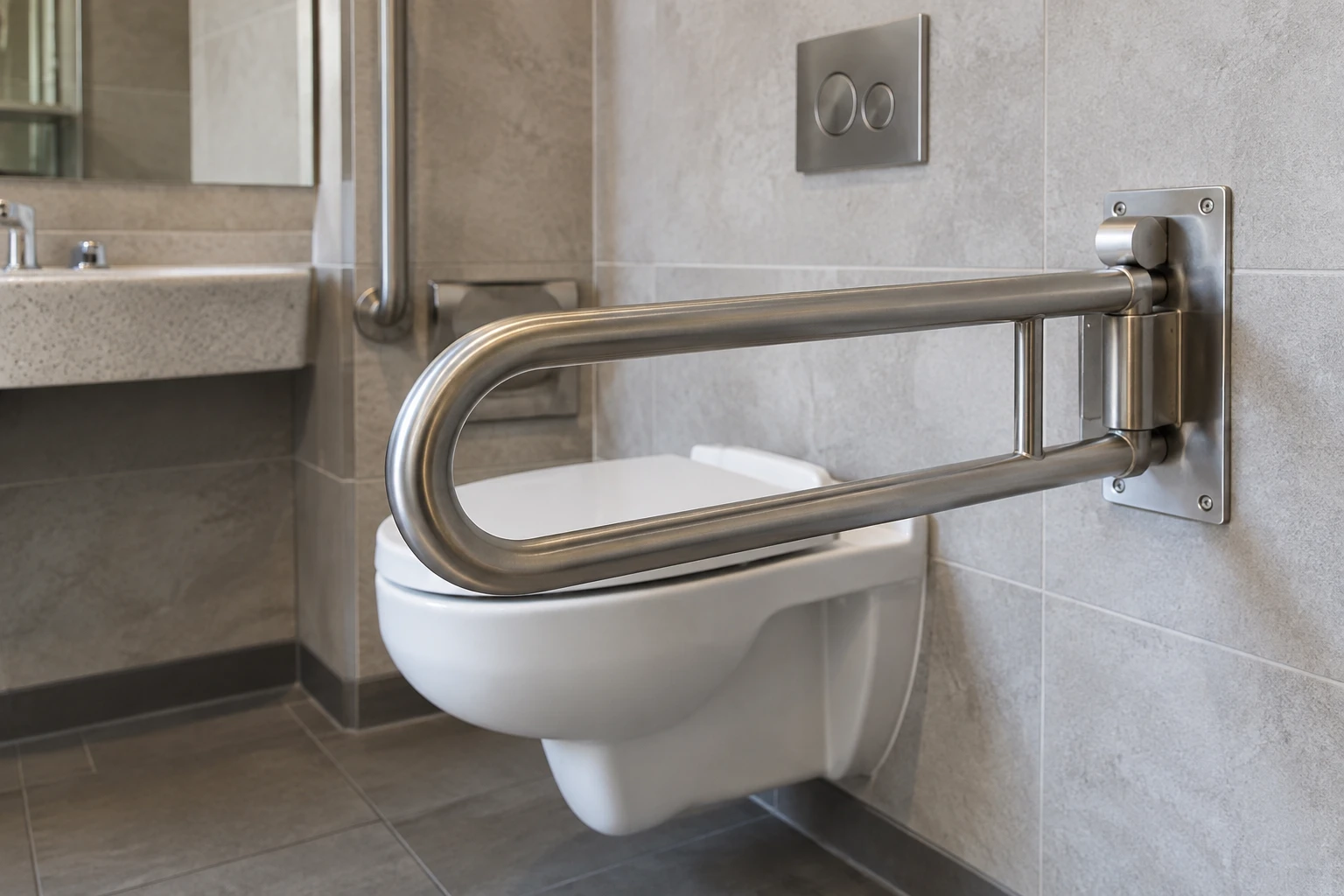
Fold-down grab rails in busy England washrooms need a planned maintenance routine, not occasional attention. High footfall means hinges, locking mechanisms and fixings are worked dozens or hundreds of times a day, and a rail that folds or locks unreliably is a safety issue as well as an accessibility one. This article sets out a servicing framework built around manufacturer documentation and recorded inspections, and explains when replacement is the better option than repair. For placement and design requirements, refer your project team to Approved Document M, the statutory guidance for building work in England, published at https://www.gov.uk/government/publications/access-to-and-use-of-buildings-approved-document-m
Why maintenance matters more for fold-down rails
A fixed rail has no moving parts. A fold-down rail has a hinge, a locking or detent mechanism, and hardware that is operated by every user. In a high-traffic washroom, that mechanism is cycled constantly, and wear shows up as sagging, loose locking, rattling or difficulty moving the rail between positions.
Approved Document M is statutory guidance for building work in England, with separate volumes for dwellings and for buildings other than dwellings. It is not a product certification, and following it at installation stage does not remove the duty to keep the installed fitting in working order afterwards. A rail that was compliant on day one can become unsafe through neglect.
Build the routine around manufacturer documentation
The starting point is the documentation supplied with the specific model. Do not assume a generic schedule applies to every rail on site. For each rail in the building, collect and file:
- The manufacturer's maintenance and cleaning instructions for that model.
- Any service or inspection intervals the manufacturer states.
- The model reference, batch or serial information, so records match the installed units.
- Contact details for technical support or spare part enquiries.
If you hold no maintenance documentation for an installed rail, request model-specific information from the supplier before writing the schedule. Flanso can provide model-specific information on request via https://flanso.com/#contact
What to check: hinges, locking and fixings
A practical inspection routine for fold-down rails covers three areas. All checks should be carried out by a competent person, and anything involving the wall fixing or structure should be referred to a qualified installer.
- Hinge operation. The rail should fold down and lift up smoothly, without excessive play at the pivot. Stiffness, grinding or free movement all indicate wear or contamination.
- Locking mechanism. Where the model has a locking function, confirm the rail engages positively in the down position and holds securely. Any slippage under normal use should be treated as a fault, not a nuisance.
- Mounting and fixings. Check that the rail is firmly secured with no movement at the wall plate. Loose or corroded fixings, or signs of movement in the substrate, should be escalated to a qualified installer before the rail is returned to service.
Cleaning is part of maintenance as well. Follow the manufacturer's cleaning instructions, since aggressive or inappropriate cleaning agents can degrade finishes and, over time, the mechanism itself. This is particularly relevant in high-traffic washrooms where cleaning frequency is high.
Keep inspection records
An undocumented inspection is of limited value. For each check, record:
- Date and location of the rail inspected.
- Who carried out the inspection and their competence.
- What was checked and what was found.
- Any action taken, parts ordered, or escalation to a qualified installer.
- Confirmation when a fault was remedied and the rail returned to service.
Keeping records against model references rather than room numbers alone makes it easier to spot patterns, for example one model or batch requiring repeated attention. Records also demonstrate that the duty to maintain accessible provision is being actively managed, which matters if an incident or complaint arises.
When to replace rather than repair
Repair makes sense where a fault is isolated, such as a worn part the manufacturer supplies as a spare and where the manufacturer's instructions permit replacement. Replacement is generally the better route where:
- The hinge or locking mechanism is worn beyond what the manufacturer supports with spare parts.
- The wall fixing or substrate shows movement or damage that a qualified installer assesses as compromised.
- The rail has repeated faults despite servicing, indicating cumulative wear.
- The model is discontinued and manufacturer documentation or parts are no longer available.
Always weigh repair against the manufacturer's own guidance. A repair that the manufacturer does not sanction leaves you with no documented basis for the rail's continued fitness.
Involve the right people
The project designer is responsible for the washroom layout and specification decisions, and a qualified installer should carry out any work involving fixings or the wall structure. Facility teams should manage the inspection schedule and records. Where wall construction or anchoring questions arise, see the guidance at https://flanso.com/#anchoring
Project checklist
- Collect manufacturer maintenance, cleaning and service documentation for every installed fold-down rail model.
- Request model-specific information from suppliers where documentation is missing.
- Set an inspection frequency proportionate to footfall, based on manufacturer guidance.
- Log hinge, locking and fixing checks against model references, with dates and findings.
- Escalate fixing, movement or substrate concerns to a qualified installer immediately.
- Remove any rail with a locking or hinge fault from service until remedied.
- Replace where faults recur or where the manufacturer no longer supports the model with parts or documentation.
- Review records periodically to identify models or locations needing closer attention.
For model-specific product and maintenance information for Flanso fold-down rails, submit an enquiry at https://flanso.com/#contact