
Field notes / DE
Duschgriff or Stützgriff? Terminology and Scope in German Washroom Specifications
In German washroom documentation, a Duschgriff and a Stützgriff are not interchangeable terms. How product types differ, which rails suit shower zones, and what evidence to request.
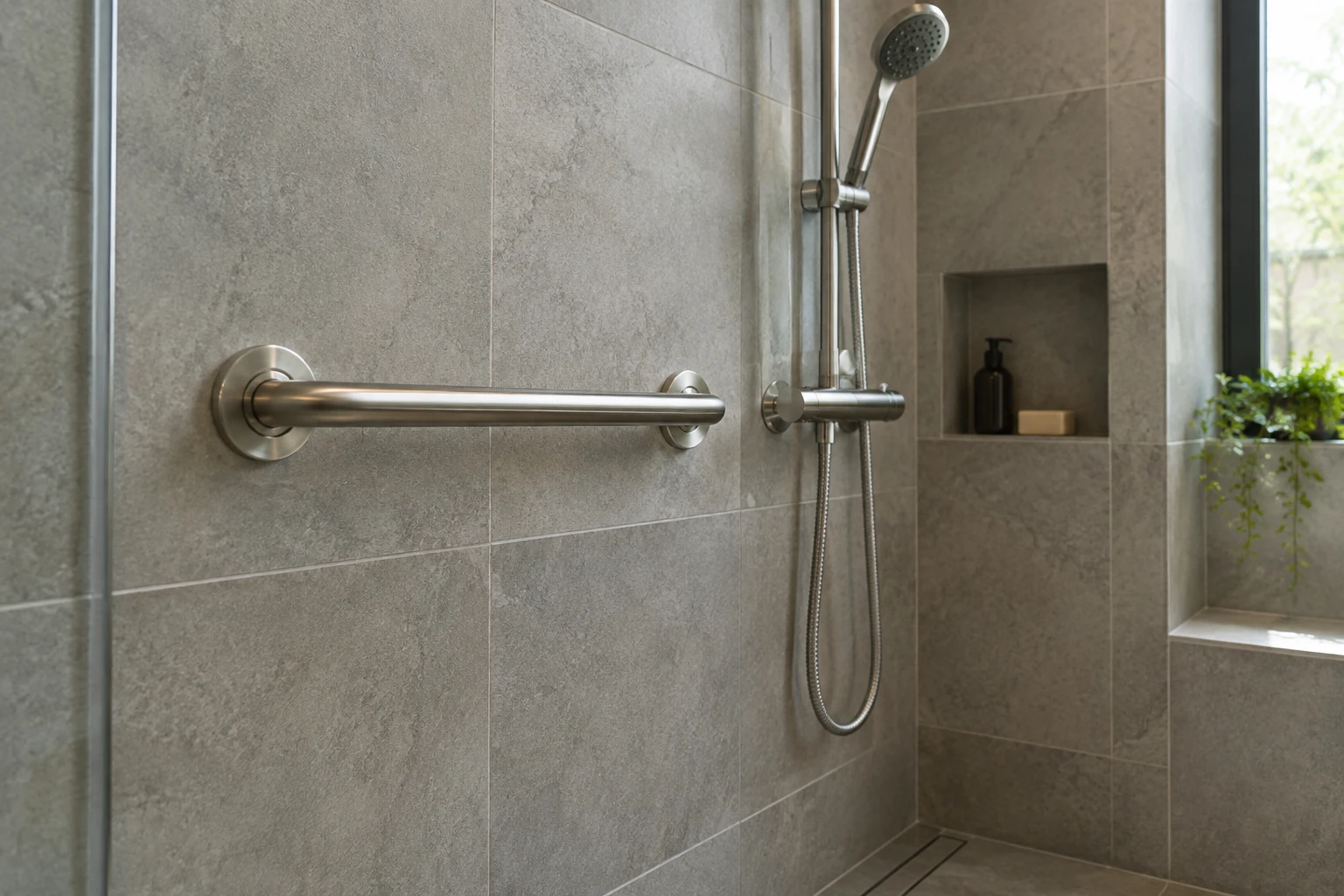
In German product documentation, a Duschgriff (shower handle) and a Stützgriff or Haltegriff (support rail) are not interchangeable terms. A Duschgriff describes a handle positioned in or near a shower zone primarily to help a person steady themselves while moving under running water. A Stützgriff or Haltegriff carries a broader and more demanding meaning: a fixed support rail intended to bear body weight during transfers and movements across the washroom. Confusing the two in a specification can lead to products being evaluated against the wrong expectations, and to tenders that omit the evidence a project actually needs.
Why the terminology matters in specifications
German planning practice for publicly accessible buildings commonly works with DIN 18040-1 as a recognized framework. The Bundesfachstelle Barrierefreiheit identifies this standard in its guidance on accessible building planning, while noting that the project must check the applicable state building requirements and the building type (https://www.bundesfachstelle-barrierefreiheit.de/DE/Fachwissen/Gebaeude/gebaeude_node.html).
Against that background, terminology discipline matters for three reasons:
- A handle marketed as a Duschgriff may be designed as a steadying aid rather than as a structural support element. The product name alone does not tell you which role it can take in your layout.
- If a tender line simply says Haltegriff without defining position, purpose and required documentation, suppliers may quote products of very different construction and load capability.
- A rail alone cannot establish building accessibility. The Bundesfachstelle's guidance frames accessible planning at building level; the rail is one coordinated element within a larger scope.
Write the specification so that each rail is described by its function in the room, not only by a product family name.
Duschgriff versus Stützgriff in product documentation
When you compare manufacturer documentation, look for how the product is described rather than how it is named. In practice you will encounter:
- Shower-zone handles (Duschgriffe): positioned within or adjacent to the shower area for grip while standing or moving in the wet zone. Documentation should state intended use and any load assumptions the manufacturer applies.
- Fixed support rails (Stützgriffe/Haltegriffe): wall-mounted rails intended to support weight during sitting and standing transfers, for example beside a WC or at a shower entry. Documentation should state the manufacturer's load and fixing requirements.
- Hinged (fold-down) rails (Stützklappgriffe): used where a fixed rail would obstruct a transfer or a fixture. These carry additional requirements around hinge mechanism, locking position and wall construction, which should be documented by the manufacturer.
The same physical rail can appear in catalogues under several names. Do not rely on the label; request the manufacturer's written statement of intended use and, where relevant, load-related documentation for the specific model. Flanso does not publish a universal dimension sheet covering all situations, so ask for model-specific information rather than assuming figures carry across a range.
Which rail types serve shower zones
In German commercial and care washrooms, shower zones typically combine several elements:
- Fixed rails near the shower entry, where a person moves from dry to wet floor.
- Handles or rails within the shower area itself, positioned to suit the standing or seated user scenario defined by the project designer.
- Where a fold-down seat is specified, a coordinated rail arrangement so that the seated user has a reachable support point.
The placement decisions belong to the project designer, working from the applicable requirements for the building type and the state building rules. The role of the specification is to make sure the products quoted can fulfil the designed positions: correct orientation, correct fixing concept for the wall construction, and documented intended use.
What evidence to request from manufacturers
A disciplined enquiry reduces rework at submittal stage. For each rail model, request:
- A written statement of intended use: steadying handle, support rail, or fold-down rail with locking function.
- The manufacturer's stated load assumptions or load-related documentation for that specific model, where the manufacturer provides it.
- Fixing and wall construction requirements, so the qualified installer can confirm the substrate and load path on site.
- Material, surface finish and cleaning guidance appropriate to a wet, frequently cleaned environment.
- Any test reports or conformity documents the manufacturer holds for the model, requested rather than assumed.
Keep evidence requests model-specific. A certificate or report attached to one product family does not transfer automatically to another model in the same range.
Recording decisions in the specification
Structure the rail schedule so each line answers the same questions: room and zone, function (Duschgriff use or Stützgriff use), product type, model reference, and the documentation attached. Note where positions follow the project designer's layout and which official sources the designer referenced, such as the DIN 18040-1 planning framework described by the Bundesfachstelle Barrierefreiheit. Record the applicable state building requirements and building type at the head of the schedule, since these determine what the project must achieve.
For anchoring and load-path questions, coordinate early with the qualified installer and the wall construction trade; see the project notes at https://flanso.com/#anchoring.
Project checklist
- Confirm the applicable state building requirements and building type for the project, and note them in the specification.
- Reference the DIN 18040-1 planning framework as described by the Bundesfachstelle Barrierefreiheit, without treating it as a substitute for project-specific requirements.
- Classify each scheduled rail by function: shower-zone handle, fixed support rail, or fold-down rail.
- Request model-specific intended-use statements and load-related documentation from each manufacturer.
- Confirm wall construction and fixing requirements with the qualified installer before ordering.
- Attach all manufacturer evidence to the tender line it relates to, rather than to the product family.
For model-specific information on Flanso rails and documentation, send a project enquiry via https://flanso.com/#contact.