
Field notes / DE
Shower Grab Rails Without Drilling: Why They Rarely Belong in German Commercial Washrooms
No-drill and suction-mounted shower handles generally cannot provide verifiable fixed support in German commercial and care washrooms. Here is why specifiers should plan anchored rails instead, and what to document.
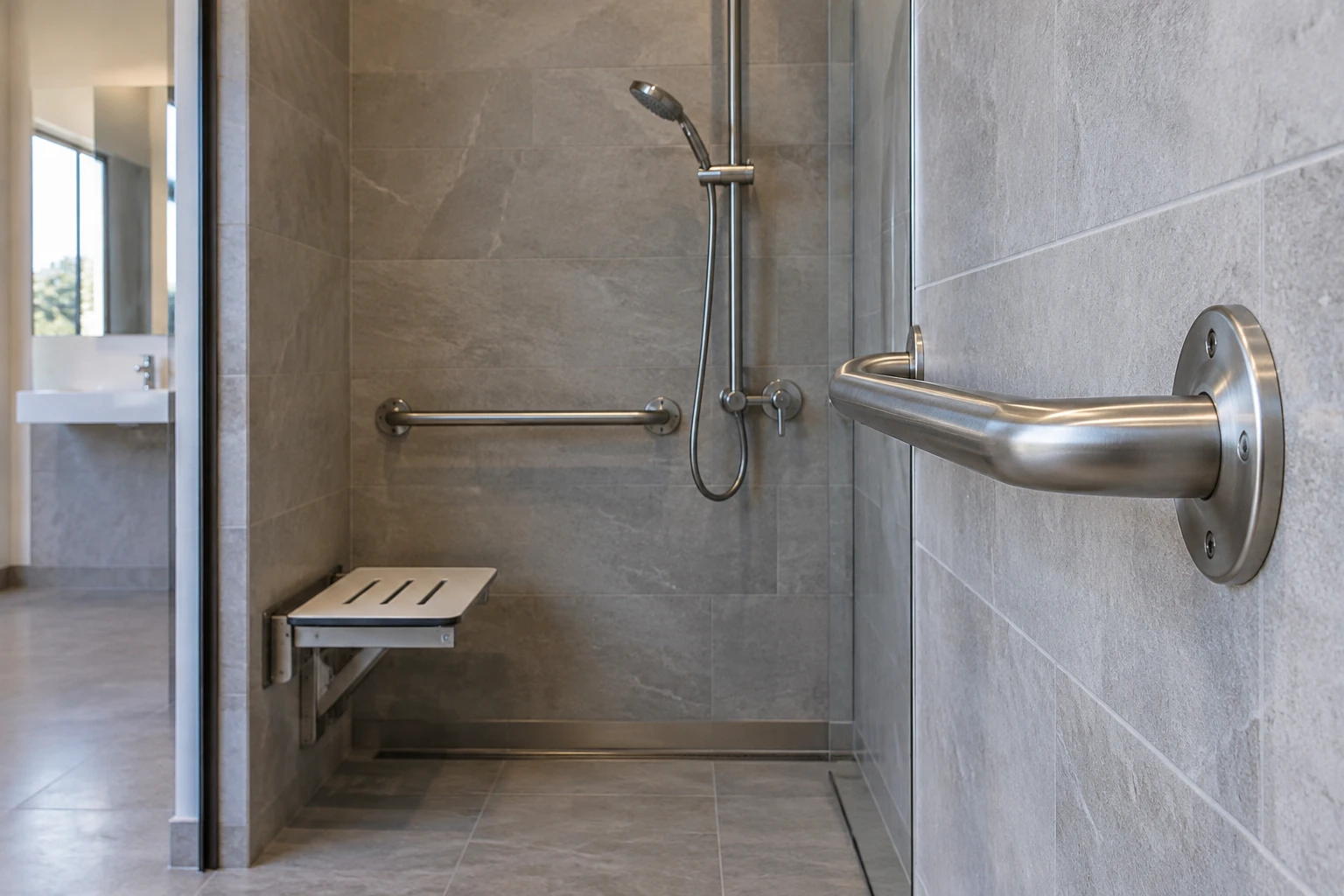
For commercial and care washrooms in Germany, a shower handle fitted without drilling is generally the wrong choice. Suction-mounted and other no-drill handles cannot be reliably anchored to the wall structure, cannot demonstrate a verifiable load path, and are difficult to justify in a documented specification. For showers where support is planned, the appropriate solution is a fixed rail anchored into suitable wall construction, selected and installed with the project designer and a qualified installer.
Why the no-drill search usually points the wrong way
The search term "haltegriff dusche ohne bohren" often reflects a private-bathroom mindset: tenants and homeowners want support without damaging tiles or waterproofing. In commercial projects the priorities are different. A rail in a hotel bathroom, care home shower or staff washroom is part of the building's safety provision, and its suitability rests on how it is anchored, not on how convenient it is to fit.
No-drill products typically rely on suction, adhesive or clamping mechanisms. These attach to the finished surface, not to the wall structure behind it. That disconnect matters most in showers, where surfaces are wet, cleaning regimes are aggressive, and users may load the rail heavily during a slip. A fitting that can detach without warning is not a support rail in any planning sense.
Load assumptions and the missing load path
A fixed support rail works because forces travel from the rail through its fixings into a structural substrate. Suction and adhesive fittings interrupt that path. Their holding capacity depends on surface condition, moisture, temperature and cleaning products, and it degrades over time in ways that no routine check can fully capture.
In a German commercial context, the specifier must be able to show that the chosen rail and its fixing concept are appropriate for the intended use. With a no-drill handle there is no meaningful answer to that question. This is a key reason suction rails are excluded from serious commercial specifications, and why earlier guidance on suction grab bars in commercial washrooms reaches the same conclusion. The project designer decides which rails are required and where; the qualified installer and, where relevant, a structural assessor confirm the wall can carry them.
Liability and maintenance records
When a support fitting fails in a commercial washroom, questions follow quickly: what was specified, what evidence supported the choice, and what was inspected. A fixed rail anchored into verified wall construction can be documented: model, substrate, fixing concept and inspection schedule. A suction handle cannot be documented in the same way, because its holding force is temporary by design and cannot be certified against a defined use case.
This creates practical problems for facility managers:
- No inspection method can prove a suction fitting will hold when needed next.
- Replacement cycles become guesses rather than scheduled maintenance.
- Incident liability falls on decisions that were never supported by evidence.
A washroom planned under recognised accessibility frameworks needs consistent, serviceable provision. Mixing one no-drill handle into an otherwise fixed scope undermines the whole specification.
The German planning framework
The Bundesfachstelle Barrierefreiheit identifies DIN 18040-1 as a recognised planning framework for publicly accessible buildings. The applicable state building requirements and the building type determine what the project must achieve, and a rail on its own cannot establish that a building is accessible. You can review the federal office's building guidance at https://www.bundesfachstelle-barrierefreiheit.de/DE/Fachwissen/Gebaeude/gebaeude_node.html.
In practice this means rail decisions sit inside a coordinated scope: placement, heights and types come from the project's planning basis, and the wall construction must be capable of receiving the fixings the specified rails require. None of that leaves room for a fitting whose attachment is provisional.
What to specify instead of a no-drill handle
Where a shower requires support, the alternative is a fixed rail matched to the project's planning documents. In German commercial and care projects this typically means:
- Fixed straight or angled rails in stainless steel or comparable materials, suited to wet and heavily cleaned environments.
- Anchoring into substrates verified during the wall construction check, coordinated with the qualified installer.
- Where transfers or limited strength require it, hinged (stützklappgriff) rails, specified with the manufacturer's locking and load documentation for that model.
- Coordination with any fold-down shower seat in the same shower area, so rails and seating work as one arrangement.
Request model-specific product information, including intended use and any maintenance guidance, directly from the manufacturer before ordering. Do not assume that a product's presence in a catalogue proves suitability for a given wall type or load scenario.
Project checklist
Before finalising the shower rail scope in a German commercial or care washroom:
- Confirm the applicable state building requirements and building type with the project designer.
- Reference the current planning framework via the Bundesfachstelle Barrierefreiheit: https://www.bundesfachstelle-barrierefreiheit.de/DE/Fachwissen/Gebaeude/gebaeude_node.html.
- Exclude suction and other surface-attached handles from the specification.
- Verify shower wall construction before selecting fixing concepts; see https://flanso.com/#anchoring.
- Request model-specific documentation from the manufacturer for every rail type.
- Hand anchoring and installation decisions to the qualified installer.
- Record the rail schedule, evidence and maintenance expectations in the project file.
For product enquiries and model-specific documentation, contact Flanso at https://flanso.com/#contact. An illustrative photo of an installed rail does not demonstrate compliance; the documented decisions behind it do.