
Field notes / US
Grab Bar Mounting Bracket: Specifying Bracket and Wall Together
Why the bracket, fasteners and supporting wall should be reviewed as one assembly under US ADA section 609.8, and what evidence to request from suppliers.
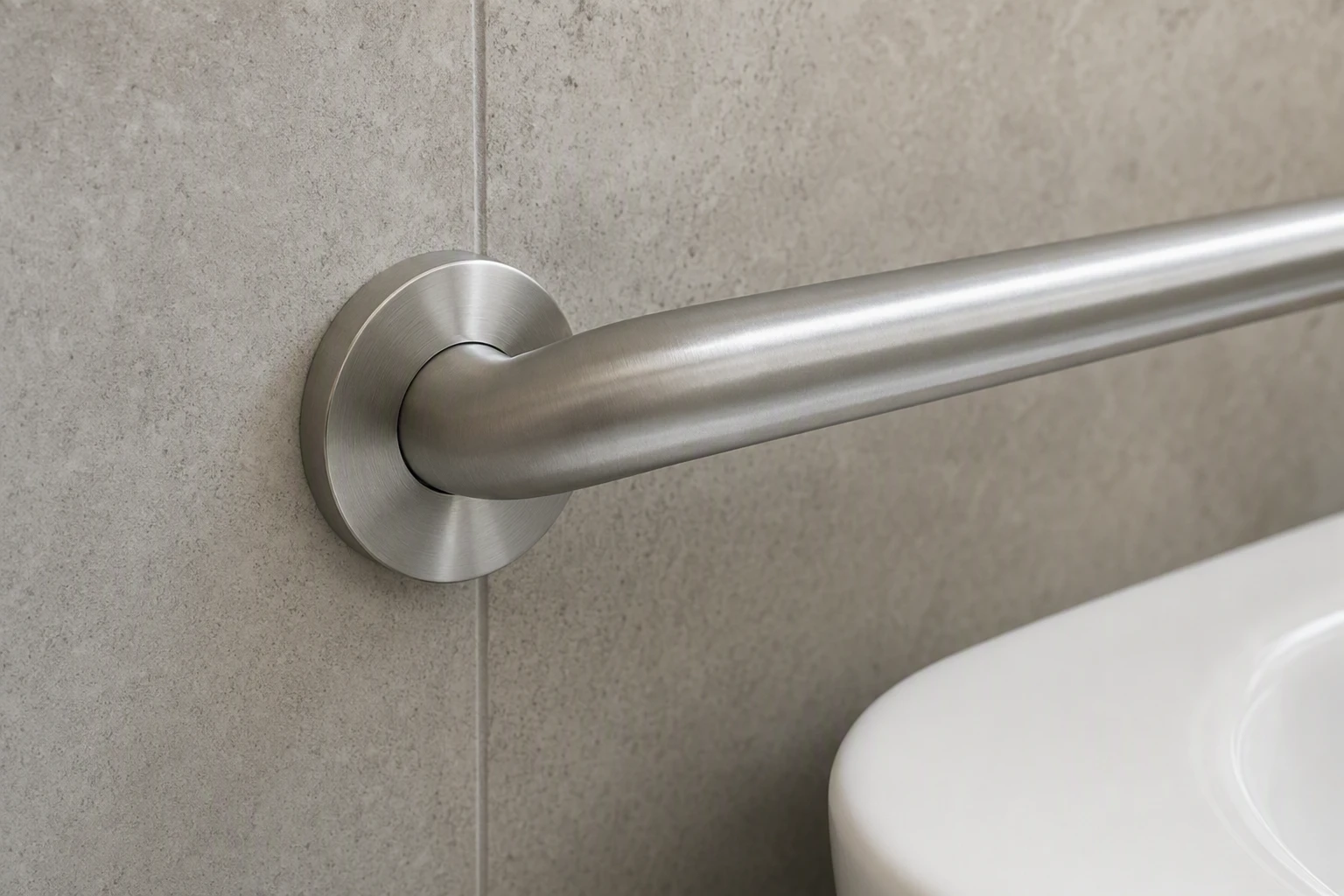
For a commercial washroom in the United States, a grab bar mounting bracket should not be specified in isolation. Under the 2010 ADA Standards for Accessible Design, section 609.8 assesses the grab bar, its fasteners and mounting, and the supporting structure together under a 250 pound (1112 N) force. That makes the bracket and the wall behind it a single structural question, and they belong in the same specification review. The official combined standards text is published by the US Access Board at https://www.access-board.gov/ada/.
What the standard actually asks of the assembly
Section 609.8, Structural Strength, applies a 250 pound (1112 N) force to the grab bar assembly and evaluates the bar, fasteners, mounting and supporting structure as a system. This is a requirement in the standard. It is not a Flanso product test result, and it does not become one because a bar is described as ADA compliant.
The practical consequence for specifiers is that a bracket catalogue entry tells you only part of the story. A well made bracket attached to an inadequate wall will not satisfy the requirement. A strong wall with an unsuitable bracket may fail just as readily. The standard is written the way it is precisely because the assembly, not the component, carries the load.
Assembly evidence rather than an anchoring recipe
This article deliberately stops short of telling anyone how to anchor a rail. That decision belongs to the project designer and the qualified installer, working from the substrate on site and the manufacturer's model specific instructions. What a specifier can and should do is assemble evidence that the system has been considered as a whole. Useful items to request or record include:
- The manufacturer's installation instructions for the specific bracket model, not a generic sheet.
- Any statements the manufacturer makes about the mounting method the bracket is designed for.
- Confirmation of the substrate and backing at the installation location, established on site.
- The project designer's approach to demonstrating compliance with section 609.8 for the installed assembly.
None of this substitutes for the designer's judgment, but it gives the designer and installer the information they need.
Where the bracket sits in the wider section 609 picture
The bracket is one element within section 609, which governs grab bars generally. Other provisions shape the specification before strength is even discussed. Section 609.2.1 sets the outside diameter of circular cross section grab bars between 1.25 and 2 inches (32 and 51 mm given in the standard), which determines the geometry the bracket must receive. Section 609.4 generally measures horizontal grab bar height to the top of the gripping surface, between 33 and 36 inches (840 and 915 mm) above the finish floor, with separate provisions for children's water closets and the lower bathtub back-wall rail; that range should not be applied to those exceptions.
Note also that section 610 addresses seats, not grab bar requirements. If a product sheet leans on seat provisions to support a grab bar claim, treat that as a documentation gap.
Why bracket and wall often get separated in procurement
In practice, brackets get specified by the fixture supplier and walls get designed by the structural or architectural team, sometimes months apart. Backing requirements can be missed when the wall assembly is finalised before the rail selection is confirmed. The fix is procedural rather than technical: put the bracket, the fastener approach and the substrate on the same review agenda, and require that the installation instructions for the chosen model be issued to the installer before wall closure. Flanso's anchoring notes for project teams are collected at https://flanso.com/#anchoring.
Questions to put to the supplier
When a grab bar and its mounting bracket are described as ADA compliant, ask what that claim actually covers. Reasonable questions include:
- Which model and bracket combination does the compliance statement refer to?
- Does the supplier provide model specific installation instructions, and in what format?
- What information does the supplier provide about the mounting conditions the product is designed for?
- Does the supplier claim to have tested the product, or is the claim based on the requirements of the standard? These are different things, and only the first is a claim about the product.
Ask Flanso for model specific information through the project enquiry form at https://flanso.com/#contact rather than assuming a catalogue entry answers these points.
Handing over to the project team
The final demonstration of section 609.8 compliance rests with the project designer and the qualified installer, who can see the substrate, confirm the backing and follow the manufacturer's instructions for the specified model. A specifier's job is to make sure they receive a complete package: the correct bar geometry under 609.2.1, the height provisions of 609.4 applied to the right fixture type, and a bracket and wall reviewed together rather than separately.
Project checklist
Before finalising a grab bar bracket specification for a US commercial washroom:
- Confirm the applicable sections of the 2010 ADA Standards at https://www.access-board.gov/ada/, including 609.2.1, 609.4 and 609.8.
- Check whether any separate provisions for children's water closets or bathtub rails apply to your fixture.
- Obtain installation instructions for the specific bracket model, not generic guidance.
- Record the substrate and backing at each installation location.
- Ensure the project designer has a stated approach to demonstrating 609.8 structural strength for the installed assembly.
- Brief the qualified installer before wall closure and confirm they have the manufacturer's documents.
- Keep supplier claims about compliance separate from any evidence of product testing, and request clarification where the distinction is unclear.