
Field notes / DE
Haltegriff Edelstahl: Specifying Stainless Steel Support Rails for German Commercial Washrooms
Finish choices, cleaning compatibility and the manufacturer documentation to request when specifying stainless steel Haltegriffe for German commercial washroom projects.
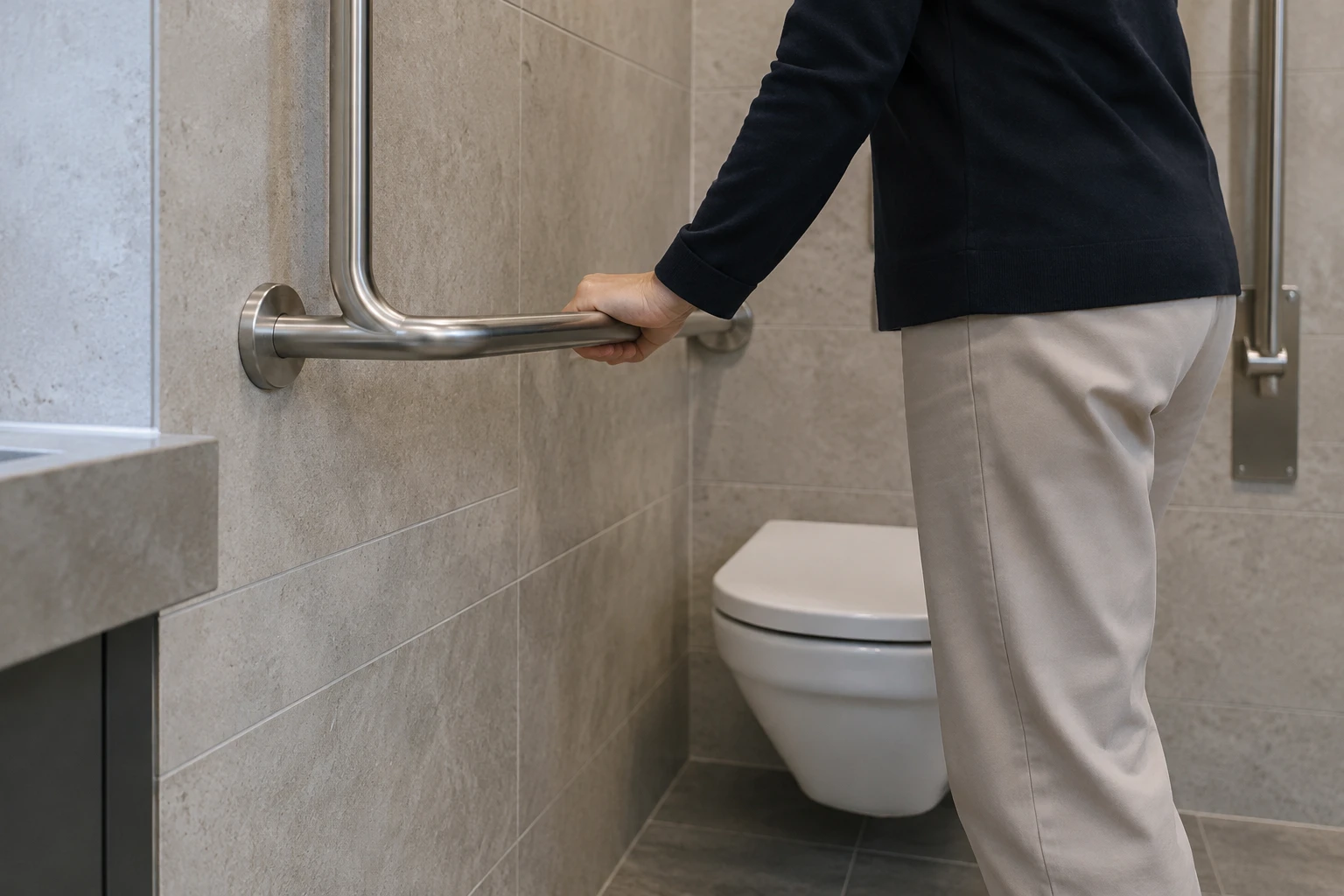
For German commercial washrooms, a Haltegriff Edelstahl is usually the default choice for fixed support rails: stainless steel offers corrosion resistance in wet areas, a surface that tolerates regular cleaning, and a finish range that can be matched to other washroom hardware. What matters at specification stage is not only the material, but the surface finish, its compatibility with the facility's cleaning regime, and the maintenance documentation the manufacturer can supply for the exact model.
The German planning framework around the rail
Before comparing finishes, be clear on what the specification must achieve. The Bundesfachstelle Barrierefreiheit identifies DIN 18040-1 as a recognised planning framework for publicly accessible buildings in Germany (https://www.bundesfachstelle-barrierefreiheit.de/DE/Fachwissen/Gebaeude/gebaeude_node.html). The project must also check the applicable state building requirements and the building type, because these determine what is actually required. A rail alone cannot establish building accessibility: it is one component within a coordinated room layout that includes fixtures, circulation space and, where planned, seating.
This means the material and finish decision sits inside a larger specification. Document the rail choice as part of the room scope, and keep the normative and regulatory questions with the project designer rather than resolving them through product selection alone.
Why stainless steel dominates German commercial specifications
Stainless steel is widely specified for wet and high-traffic washroom environments because it resists corrosion, withstands frequent cleaning, and does not rely on coatings that can chip or wear. For facilities, this typically translates into a long service life and a surface that can be inspected easily for damage or wear.
That said, not all stainless rails are identical. Surface condition, weld quality at brackets and joints, and the finish applied all affect both appearance and cleanability over time. Ask each supplier to describe the material grade, surface treatment and construction of the specific models quoted, and request this information in writing as part of the submittal package.
Finish choices and what they mean in practice
Common finish options for stainless steel support rails include:
- Brushed or satin finishes. These diffuse light and tend to show water marks and fingerprints less than polished surfaces, which is often preferred in high-traffic public washrooms.
- Polished finishes. These are easier to wipe smooth but can show smudging more readily and create more visible reflections, which some users find distracting in wet areas.
- Coated or coloured variants. Some ranges offer powder-coated or antibacterial coatings. If these are quoted, ask the manufacturer how the coating performs under the facility's cleaning agents and disinfection schedule, and what happens when the coating wears.
Whatever finish is chosen, confirm with the manufacturer that it is suitable for the cleaning products the facility actually uses. Cleaning compatibility is a manufacturer question, not something the specifier should assume.
Cleaning compatibility and maintenance documentation
In care settings, clinics and high-traffic public buildings, cleaning regimes can involve aggressive agents, frequent wipe-downs and disinfection cycles. For each quoted model, request:
- The manufacturer's cleaning and care instructions, including any cleaning agents that must be avoided.
- Information on how the surface and any coatings behave under the facility's disinfection regime.
- Recommended inspection intervals and what to check (fixings, surface damage, wear at grip zones).
- Guidance on when repair versus replacement is advised.
- Availability of spare parts and fixings for the model.
Keeping this documentation with the project record makes it possible to maintain the rails consistently over the building's life, and gives facility managers something to reference when cleaning staff or contractors change.
What to request in the enquiry
A structured enquiry gets comparable answers from suppliers. Ask each bidder for:
- Exact model designation, material and finish description.
- Manufacturer cleaning and care documentation for that model.
- Any manufacturer information on mounting requirements, for handover to the project designer and the qualified installer.
- Statement of which parts are replaceable and how spares are ordered.
- Delivery information for the quantities and finishes quoted.
Do not ask suppliers to confirm compliance with building requirements on the project's behalf. The applicability of DIN 18040-1 and the relevant state building rules is a design-stage determination, supported by official sources such as the Bundesfachstelle Barrierefreiheit guidance page.
Coordinating rails, walls and installation
A stainless steel rail is only as sound as the wall and fixing behind it. Wall construction, load path and anchoring belong to the project designer and the qualified installer, and the anchoring questions should be resolved before orders are placed. Flanso provides general anchoring information for project teams here: https://flanso.com/#anchoring.
Note that photos of installed rails, including illustrative images in catalogues, do not prove that a particular installation meets the project's requirements. Compliance is established through the planning documents and the actual installation, not through imagery.
Project checklist
- Confirm the applicable state building requirements and building type with the project designer; reference DIN 18040-1 via the Bundesfachstelle Barrierefreiheit as the recognised planning framework (https://www.bundesfachstelle-barrierefreiheit.de/DE/Fachwissen/Gebaeude/gebaeude_node.html).
- Define the rail schedule by room: WC, shower and basin areas as one coordinated scope.
- Specify material and finish per model, and confirm the finish suits the facility's cleaning regime.
- Request cleaning, care and maintenance documentation from each manufacturer for the exact quoted models.
- Clarify spare parts availability and inspection guidance before award.
- Hand wall construction and anchoring questions to the project designer and qualified installer (see https://flanso.com/#anchoring).
- Keep the full documentation set in the project record for facility management.
For model-specific information on Flanso stainless steel rails, including finish options and maintenance documentation, submit a project enquiry at https://flanso.com/#contact.