
Field notes / DE
Haltegriff Toilette: Terminology and Evidence in German WC Rail Enquiries
How Haltegriff and Stützgriff claims differ in supplier documentation, which rail types serve WC zones in German projects, and what load and locking evidence to request.
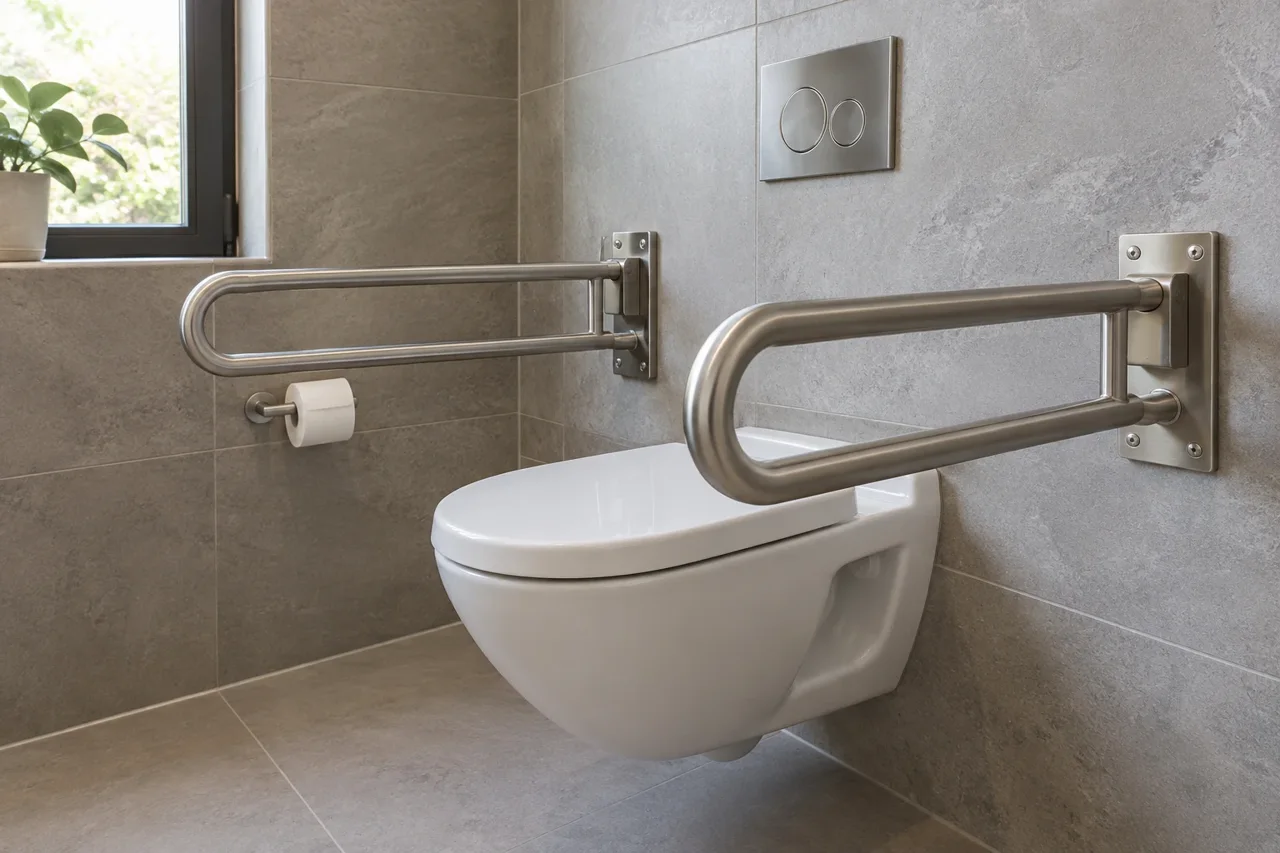
When German project buyers search for a "Haltegriff Toilette", the results mix two terms that do not mean the same thing in supplier documentation. A Haltegriff is a fixed grab or holding rail. A Stützgriff, in common specification language, describes a support rail, and a Stützklappgriff is a fold-down support rail with a hinge and locking mechanism. This article explains how the terms differ, which rail types typically serve WC zones in German commercial washrooms, and which evidence you should request from manufacturers before ordering.
Why terminology matters in German WC rail enquiries
Supplier catalogues, tender documents and installation instructions do not always use Haltegriff and Stützgriff consistently. Some manufacturers label a fixed rail as a Stützgriff; others reserve that term for fold-down models. If your specification says "Haltegriff" but the delivered product is a Stützklappgriff with a hinge, the submittal no longer matches the design intent, and hinge and locking maintenance obligations appear that nobody planned for.
For publicly accessible buildings in Germany, the federal accessibility office identifies DIN 18040-1 as a recognised planning framework, and the project must also check the applicable state building requirements and the building type (https://www.bundesfachstelle-barrierefreiheit.de/DE/Fachwissen/Gebaeude/gebaeude_node.html). A rail alone cannot establish building accessibility. When you request products, use one term consistently, and ask the supplier to confirm in writing which rail type their documentation describes.
Which rail types serve WC zones
WC zones in German commercial and care washrooms are typically specified with one of the following arrangements. The project designer decides which fits the layout and user scenarios.
- Fixed horizontal rails mounted on the wall beside or behind the WC. No moving parts, simple maintenance record, permanently in place.
- Fold-down support rails (Stützklappgriffe) on the transfer side. These contain a hinge and a locking or latching mechanism, so they require periodic checks that a fixed rail does not.
- Combined arrangements where a fixed rail on one side works with a fold-down rail on the other.
- Freestanding or clamp-on frames. These are generally not the same product category as wall-mounted rails. They sit outside the wall-fixed scope, and for commercial projects the wall-mounted route is normally the planned one.
Note that a "Duschgriff" serves the shower zone, not the WC. If a quotation includes shower handles under a WC line item, send it back for correction.
What load evidence to request from manufacturers
Manufacturers publish load information in different forms, and not all of it is comparable. Ask each supplier for:
- The stated maximum load or load assumption for the specific model, in writing, and the basis on which it is given.
- Which standard or test reference the load statement relates to, if any, and whether the statement is a manufacturer declaration or a third-party result. Never treat a standard's existence as proof that a specific product was tested to it.
- Any installation-specific conditions, such as minimum wall construction, that the load statement depends on. These belong with the structural reviewer, not with the installer alone.
If a supplier cannot state the load basis for a model, that gap should be recorded in the submittal file before an order is placed.
What locking evidence to request for fold-down rails
A Stützklappgriff introduces a moving mechanism, so the evidence list grows:
- How the rail locks in the up position and whether the locking function is user-operable or automatic.
- The manufacturer's description of expected wear parts and service intervals for hinge and lock.
- Cleaning agent compatibility for the mechanism, not only the rail surface.
- Spare parts availability for hinge and locking components.
Keep these documents with the maintenance plan for the building, so facility teams know what to inspect and when.
Separating product evidence from planning compliance
A common error in German enquiries is presenting a product document as if it proved the installation meets DIN 18040-1 or the relevant state requirements. It does not. The rail is one element in a coordinated room layout that the project designer confirms against the current official sources and the building type. Product documents tell you what the item is and what the manufacturer states about it; planning documents tell you whether the overall provision works. Keep the two files separate and cross-reference them.
Building the enquiry checklist
Before you send an enquiry for WC rails, assemble:
- The rail type per position: fixed Haltegriff or fold-down Stützklappgriff, confirmed against the designer's layout.
- Material and finish requirements, following the same logic you would apply to any stainless steel line item.
- Written load statements with their stated basis for each model.
- For fold-down models: locking description, service information and spare parts policy.
- Wall construction information for the structural reviewer, so the load path is checked before ordering.
- A note of which official source the layout references, and the date you checked it.
For model-specific information on Flanso WC rails, including load statements and maintenance documentation, contact us via our project enquiry page. Anchoring and wall construction questions should go to the project designer and the qualified installer; see our notes on anchoring for what to prepare.
Consistent terminology and complete evidence requests protect the project: the delivered rails match the specification, the maintenance team knows what to inspect, and the compliance file separates what the product is from what the building requires.