
Field notes / DE
Wandhaltegriff in German Washroom Specifications: Terminology, Wall Prerequisites and Evidence to Request
How Wandhaltegriff claims differ in German supplier documentation, what wall construction prerequisites matter, and which load and material evidence specifiers should request from manufacturers.
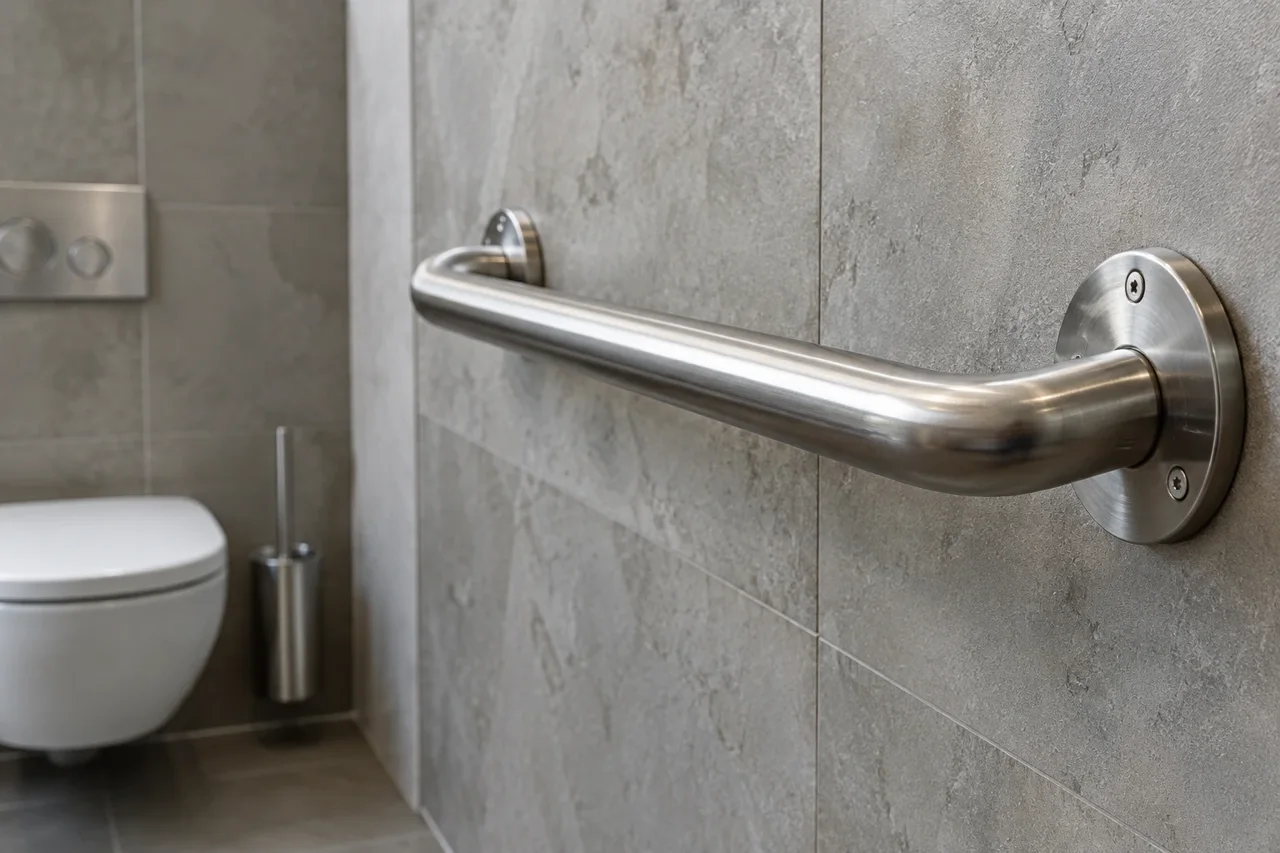
A Wandhaltegriff is a wall-mounted support rail. In German supplier documentation, the term describes the fixing type rather than a defined performance class, so the word alone tells a specifier little about load capacity, material, or suitability for a specific wall construction. This article explains how the term is used in practice, what wall prerequisites affect the specification, and what evidence to request from manufacturers at tender stage.
What Wandhaltegriff means in supplier documentation
German suppliers use several related terms, and the boundaries between them are not standardised in product marketing. A Wandhaltegriff is any support rail fixed to the wall. A Stützgriff often signals a rail intended for load-bearing support rather than a towel rail or a light mobility aid. A Klapphaltegriff or Klappstützgriff refers to a fold-down rail with a hinge and locking mechanism, which carries additional moving-part requirements. A Duschgriff is positioned for shower zones and may overlap with the support rail category.
Because the terminology is descriptive rather than regulated at the product-claim level, two documents both labelled Wandhaltegriff can describe very different products: one a stainless steel rail engineered for transfer support, the other a lightweight comfort handle. Specifiers should not rely on the product name. The manufacturer's technical documentation must state the intended use, and the enquiry should ask explicitly whether the model is designed to serve as a Stützgriff for user transfer and support.
The federal accessibility office identifies DIN 18040-1 as a recognized planning framework for publicly accessible buildings in Germany, and the project must check the applicable state building requirements and building type. A rail alone cannot establish building accessibility. This matters for terminology because the framework describes functions and positions in planning terms, while the product name in a supplier catalogue is a marketing label. The two must be reconciled in the specification, not assumed to match. See the Bundesfachstelle Barrierefreiheit overview at https://www.bundesfachstelle-barrierefreiheit.de/DE/Fachwissen/Gebaeude/gebaeude_node.html.
Why wall construction is part of the rail specification
A Wandhaltegriff is only as sound as the wall behind it. German commercial and care washrooms may have solid masonry, reinforced concrete, lightweight blockwork, or preplastered stud walls, and each presents different prerequisites for a fixed rail. The load path from the rail through the fixing into the structure is a design question, not a catalogue answer.
This has two consequences for the enquiry. First, the specification should describe the expected wall construction so the manufacturer can state which models and fixing principles are appropriate, or flag that a reinforcement or backing is required. Second, structural and installation decisions belong with the project designer and a qualified installer. The manufacturer supplies product documentation and fixing recommendations for their models; the designer confirms that the wall can carry the loads in the intended positions.
Where a project is at an early stage, it is worth reviewing wall construction questions before ordering, as covered in more detail at https://flanso.com/#anchoring.
Load evidence to request from manufacturers
Because Wandhaltegriff is not a performance claim in itself, the load documentation is the decisive evidence. Request from each candidate manufacturer:
- The stated load capacity or safe working load for the specific model, with the basis on which it is given.
- The wall types for which the stated capacity applies, and the conditions attached to it.
- Any test or assessment documentation behind the capacity figure, and which standard or method it references.
- For fold-down rails: documentation on the hinge and locking mechanism, and whether the capacity applies with the rail in the loaded, locked position.
- A clear statement of whether the capacity is a product figure or a system figure that depends on the wall build-up.
Do not accept a generic catalogue line such as suitable for accessible washrooms as a substitute for model-specific figures. If a manufacturer cannot supply load documentation for the exact model and wall condition, that is a procurement signal in itself.
Material and surface evidence
German commercial washrooms are cleaned frequently and often with aggressive agents. The material and finish therefore need documented cleaning compatibility, not just an attractive sample. Request:
- The material specification for the rail body, grip sections and fittings.
- Recommended cleaning agents and any agents that must be avoided.
- Maintenance intervals and inspection points, particularly for fold-down mechanisms.
- Information on grip surface and finish durability in high-traffic conditions.
For a deeper comparison of stainless steel grades and finishes in this context, see the related Flanso guidance on material and surface specification for German commercial washrooms.
Building the submittal file
Collect the evidence into a single package so decisions can be traced later:
- Model identification and manufacturer technical datasheets.
- Load capacity statements with their stated basis and applicable wall types.
- Cleaning and maintenance documentation per model.
- The wall construction assumptions agreed with the project designer.
- Notes recording which planning framework applies to the building type, including the state building requirements checked for the project.
This file also supports later facility management: when a rail is inspected, replaced, or when walls are altered, the original documentation is the reference point.
Project checklist
- Confirm the applicable German building requirements and building type for the project, and note that DIN 18040-1 is the recognized planning framework cited by the federal accessibility office.
- Use Wandhaltegriff, Stützgriff and Klapphaltegriff deliberately in the specification, and require manufacturers to confirm the intended use for each model.
- Survey and record wall construction per fixing location with the project designer before ordering.
- Request model-specific load documentation, including the wall conditions it applies to.
- For fold-down models, request hinge and locking documentation.
- Request cleaning and maintenance documentation per model and finish.
- Refer all structural and installation decisions to the project designer and a qualified installer.
- Ask Flanso for model-specific information for the models under consideration via https://flanso.com/#contact.
A Wandhaltegriff specification is complete only when the terminology, the wall prerequisites and the manufacturer evidence all align and are recorded in the submittal file.