
Field notes / US
Shower Grab Bars: Maintenance and Inspection in US Commercial Facilities
A facility guide to inspecting shower grab bars in high-traffic US commercial showers: fittings, finish wear, cleaning compatibility and record keeping, using manufacturer documents and official ADA guidance.
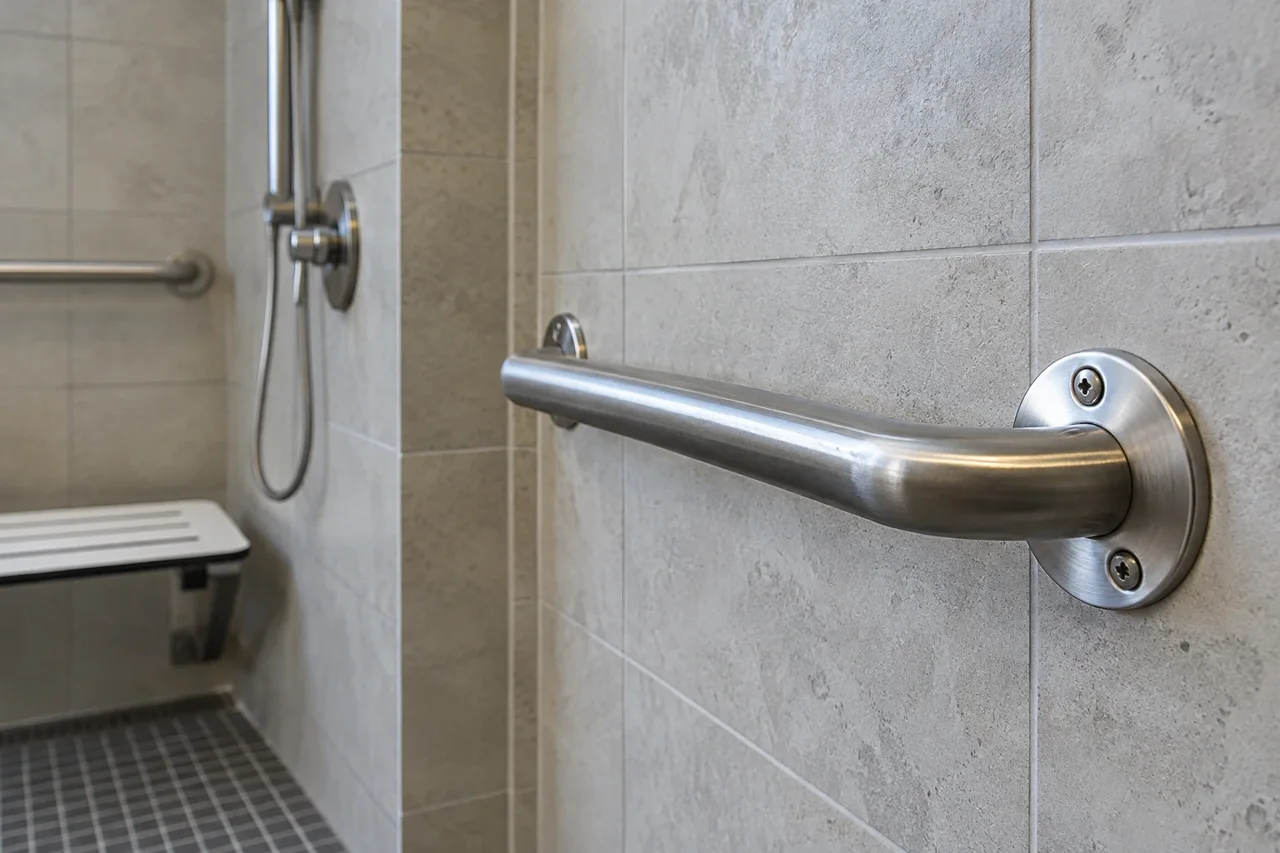
Shower grab bars in high-traffic US commercial facilities are not fit-and-forget items. Daily use, constant moisture and aggressive cleaning chemicals all work against the fitting, the finish and the wall behind it. A structured inspection and servicing regime, built on manufacturer documentation and the official ADA standards from the US Access Board, keeps shower rails dependable between retrofits. This guide applies to the United States and references the 2010 ADA Standards; it does not translate UK, German, French, Spanish or Italian requirements.
The official baseline: what the ADA Standards require
The US Department of Justice issued the ADA Standards for Accessible Design in 2010, and the US Access Board publishes the combined official text at https://www.access-board.gov/ada/. Section 609 covers grab bars. Note that Section 610 deals with shower and bathtub seats, not grab-bar requirements, so do not look to it for rail provisions.
Several 609 provisions matter for maintenance decisions:
- Section 609.2.1 sets the circular cross-section outside diameter between 1.25 and 2 inches, with 32 and 51 mm given in the standard. Worn, heavily corroded or repainted rails that drift outside this grip range no longer match the original compliance basis.
- Section 609.4 generally measures horizontal bar height to the top of the gripping surface, between 33 and 36 inches (840 and 915 mm) above the finish floor. Separate provisions apply to children's water closets and the lower bathtub back-wall rail; the general range does not apply to those exceptions.
- Section 609.8 assesses the grab bar together with its fasteners, mounting and supporting structure under a 250 pound (1112 N) force. This is the standard's requirement, not a manufacturer test result.
The 609.8 provision is the key one for maintenance: the wall structure, anchoring and fasteners are part of the compliance picture, not just the bar itself. Any inspection regime must therefore check the assembly, not only the visible rail.
Checking fittings and the load path
A shower grab bar can look sound while its anchoring degrades. Routine fitting checks should cover:
- Movement at the flanges under hand pressure. Any perceptible rocking suggests loosened fasteners or deteriorated backing.
- Fastener condition where visible, including corrosion around screws and signs of wall cracking or spalling at the mounting points.
- Evidence of water ingress behind the flanges, which in wet-area walls can progressively undermine the substrate that carries the load.
Because section 609.8 includes the supporting structure, a bar that pulls away from soft or water-damaged backing cannot be treated as serviceable, even if the rail itself is intact. Where movement or substrate damage is found, refer the repair to the project designer and a qualified installer. The scope of the fix, including re-anchoring into suitable backing, is a structural and installation decision, not a maintenance improvisation.
Finish wear and grip surface condition
High-use shower rails show wear where hands grip most often. Inspect for:
- Surface scratches, pitting or corrosion, particularly in the wet zone where cleaning chemicals concentrate.
- Any coating wear on rails supplied with a coated or textured finish. Flaking or smooth-worn coatings change the grip character and can affect cleaning compatibility.
- Residue build-up that no longer responds to the approved cleaning regime, which often signals a compromised surface.
Keep the grip cross-section within the 1.25 to 2 inch range required by section 609.2.1. Heavy paint build-up during repainting works, for example, can push a rail out of its original compliance basis. If a rail's surface condition is in question, ask the manufacturer for model-specific information on the specified finish and its care requirements rather than assuming any cleaner is safe.
Cleaning compatibility
Facility cleaning regimes frequently use products that are unsuitable for stainless or coated rail finishes. Collect and file the manufacturer's cleaning and care documentation for each installed model, brief the cleaning contractor accordingly, and record which products are approved. Unverified chemical compatibility is a common cause of premature surface degradation in wet commercial environments, and it can lead to disputes about wear during warranty or tender discussions. Where documentation is missing, request it from the supplier before authorising any new cleaning product in shower areas.
Record keeping between retrofits
A written inspection record ties maintenance activity to the original compliance documentation. For each shower location, keep:
- The product model, finish and any manufacturer submittal documents supplied at purchase.
- Inspection dates, the inspector's name and the checks performed on fittings, finish and surrounding wall.
- Cleaning products approved for each model and any deviations found.
- Repair and replacement records, including who performed the work and which parts were used.
When a retrofit changes the wall construction, fixtures or rail positions, treat the existing records as a survey baseline and involve the project designer to re-check the arrangement against the current standards text. See https://www.access-board.gov/ada/ for the official section 609 provisions.
Project checklist
- Confirm each shower grab bar model's manufacturer documentation is on file, including finish and cleaning guidance.
- Schedule routine inspections covering flange movement, fastener condition, wall condition and surface wear.
- Verify grip diameter and height remain consistent with the original compliance basis, referencing sections 609.2.1 and 609.4 of the 2010 ADA Standards.
- Escalate any movement or substrate damage to the project designer and a qualified installer; never re-anchor ad hoc.
- Record every inspection, repair and cleaning product approval in the facility log.
- Request model-specific information from Flanso for installed or proposed shower grab bars, including finish care and documentation available for the project. Do not assume any published standard alone proves a product was tested or certified.
For enquiries about shower grab bar models, finishes and available project documentation, contact Flanso at https://flanso.com/#contact. Background on anchoring considerations for wet-area walls is available at https://flanso.com/#anchoring.