
Field notes / UK
Shower Grab Rail Procurement for England Care and Commercial Tenders: Grip Profiles, Materials and Supplier Evidence
A tender-stage comparison for shower grab rails in England care and commercial buildings: grip profiles, materials, finishes and the evidence to request from suppliers, with placement decisions left to the project designer against Approved Document M.
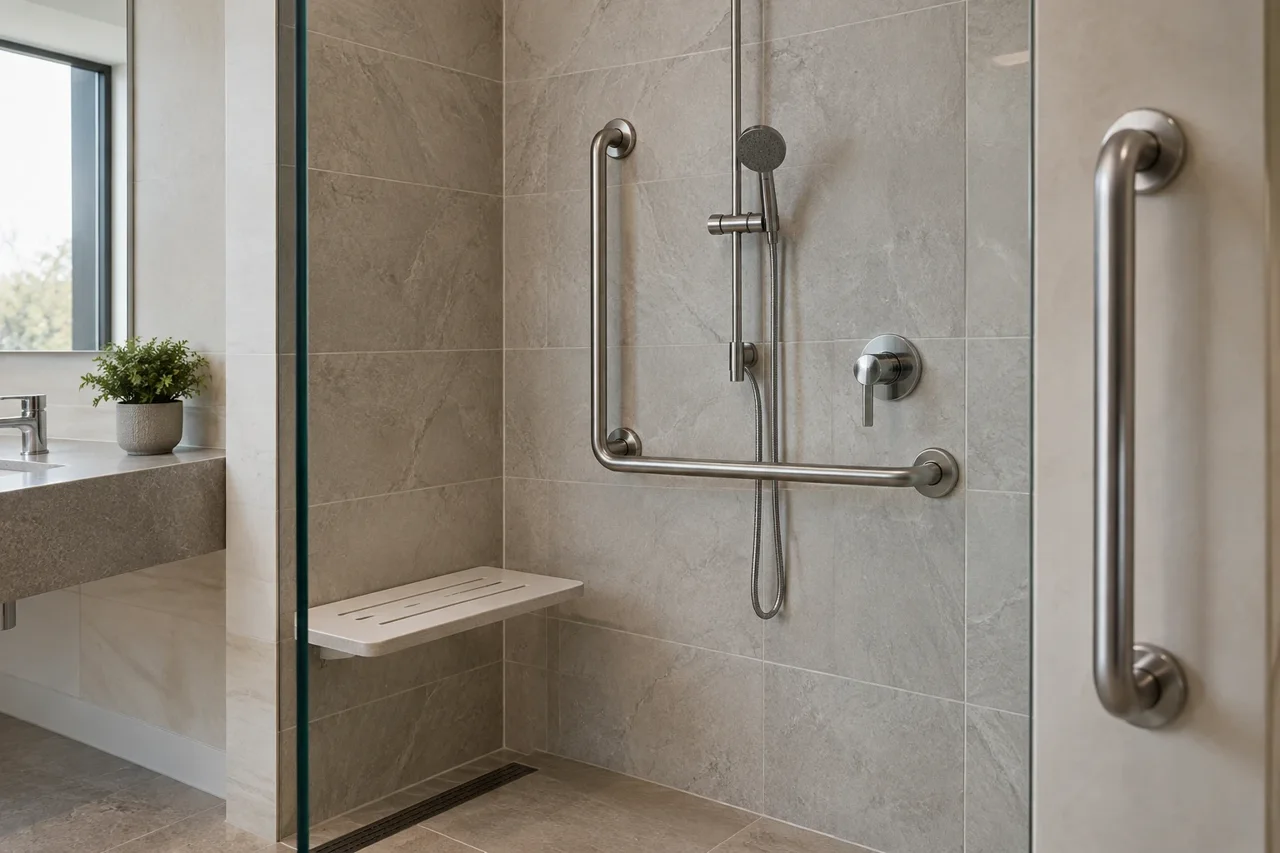
For shower grab rail enquiries at tender stage in England care homes and commercial washrooms, the most useful comparison is not between individual products but between the documentation suppliers can provide. Approved Document M is statutory guidance for building work in England, with separate volumes covering dwellings and buildings other than dwellings, and it informs where and how support should be planned rather than certifying any product. This article sets out how to compare grip profiles, materials and finishes, and what to request from suppliers before award. Placement and structural decisions rest with the project designer and qualified installer.
Start from the project context, not the catalogue
A care home en-suite shower, a leisure facility changing room and a commercial accessible shower place different demands on the same category of hardware. Before comparing products, record:
- The building type and which volume of Approved Document M applies to the works. The document is statutory guidance for building work in England and is not a universal UK or international product certification, so citing it does not by itself evidence product suitability. See the publication page at https://www.gov.uk/government/publications/access-to-and-use-of-buildings-approved-document-m
- Who the primary users are, including any occupational therapist input in care settings.
- The wall construction at the proposed fixing positions, since anchoring feasibility varies considerably.
- The cleaning regime the rails will face in service.
Keep these points in the enquiry documents so every supplier quotes against the same assumptions.
Comparing grip profiles
Grip shape affects usable grip surface, comfort for users with limited hand strength and how the rail reads on drawings. At tender, ask suppliers to describe, with drawings, the profile of each candidate rail:
- Round tube profiles: the familiar option, generally straightforward to clean, with grip comfort dependent on diameter and surface finish.
- Ergonomic or flattened profiles: shaped to spread load across the palm; useful where users push down as well as pull, but check that the profile suits both hand orientations.
- Knurled or textured zones: improve wet-hand grip but can complicate cleaning; ask how the texture behaves under the facility's disinfectant schedule.
- Flanged and unflanged ends: confirm how each option closes the wall junction and what the manufacturer says about cleaning at that detail.
Request the grip dimensions in writing per model rather than accepting generalised claims, and have the project designer confirm that the chosen profile works with the planned rail positions.
Materials and finishes
Stainless steel dominates commercial and care specifications for good reason, but there are meaningful differences to compare:
- Grade and surface treatment: ask each supplier to state the stainless grade and finish per model, and to confirm suitability for the specified cleaning chemicals.
- Coated or nylon-sleeved rails: warmer to the touch, which some care settings prefer, but check coating durability against impacts from shower trolleys or mobility aids.
- Colour-contrasted options: where the design calls for visual contrast against wall finishes, confirm the manufacturer's own specification for the contrast rather than inferring it from photographs.
Ask how finishes age in wet, high-traffic environments and what the manufacturer's maintenance documentation says about restoring surface condition.
Evidence to request from suppliers
A consistent evidence pack lets evaluators compare like with like. Request from every shortlisted supplier:
- Model-specific technical drawings with dimensions and fixing details.
- Any test reports or certifications the manufacturer holds for the specific model, identified by model number. Do not accept a reference to Approved Document M as proof that a product is certified or tested; the document is statutory guidance for building work in England, not a product standard. See https://www.gov.uk/government/publications/access-to-and-use-of-buildings-approved-document-m
- Cleaning and maintenance instructions, including approved cleaning agents.
- Spare parts availability and expected service life statements, if the manufacturer publishes them.
- Written confirmation of wall-construction prerequisites for the fixing method, with structural queries routed to the project designer and qualified installer.
Where a supplier cannot supply a document, record the gap in the tender evaluation rather than assuming the information does not matter.
Placement decisions and the tender record
Approved Document M guidance informs the design decisions about where rails should be positioned and how the shower area is arranged, but the article, illustration or photograph in this piece does not demonstrate compliant installation, and procurement documents should not treat it as doing so. In the tender record:
- Cite the relevant Approved Document M volume as the basis for design decisions. The publication page is at https://www.gov.uk/government/publications/access-to-and-use-of-buildings-approved-document-m
- Record rail positions as designer decisions, cross-referenced to the chosen product's fixing requirements.
- Note that for projects elsewhere in the UK or internationally, Approved Document M applies to building work in England and other jurisdictions have their own requirements.
Project checklist
Before issuing or evaluating a shower grab rail tender in England:
- Confirm which volume of Approved Document M applies and cite it as design guidance, not product certification.
- Obtain occupational therapist or accessibility input where the setting calls for it.
- Survey wall construction at all proposed fixing points.
- Define the cleaning regime and require supplier confirmation of chemical compatibility per finish.
- Request model-specific drawings, dimensions and any test or certification evidence, referenced by model number.
- Ask for maintenance, spare parts and inspection documentation with the quotation.
- Route all structural and installation questions to the project designer and qualified installer.
- Record evidence gaps against each supplier in the evaluation file.
For model-specific information, dimensions or documentation for Flanso shower rails, please contact us via https://flanso.com/#contact. Anchoring considerations for wall-mounted rails are outlined at https://flanso.com/#anchoring.