
Field notes / UK
Writing an OEM Enquiry for Stainless Steel Grab Rails: Drawings, Finishes, Packaging and Documentation
A practical template for specifiers preparing OEM enquiries for stainless steel grab rails in UK commercial washroom projects, covering drawings, finish references and documentation requests.
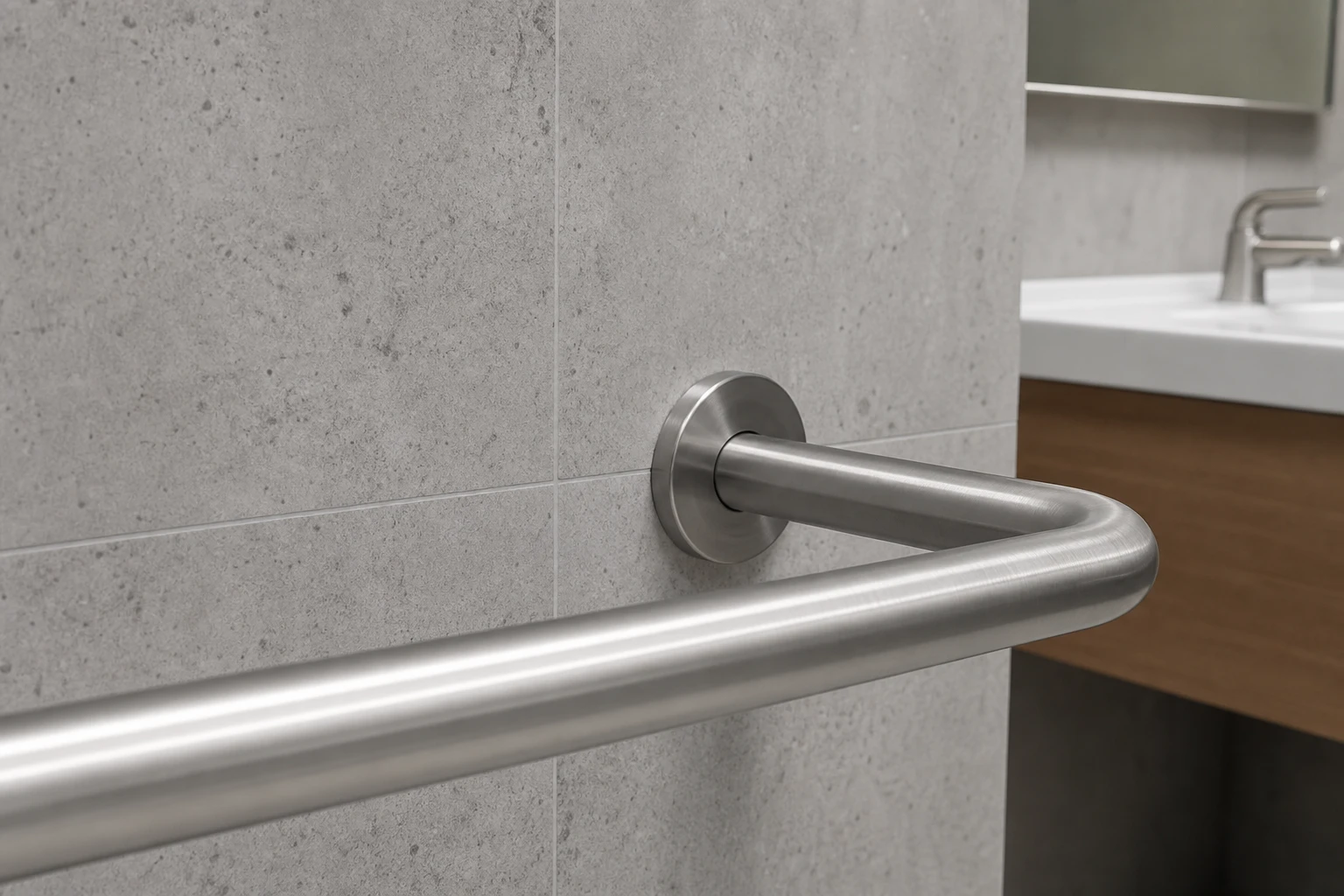
A good OEM enquiry for stainless steel grab rails states the project context, the finish reference, the drawings you expect back, how the rails should be packaged, and which documents must accompany delivery. It asks questions rather than assuming answers, and it does not treat any stock range as pre-certified for your project.
Start with the project context, not the product
Before you describe the rail, describe the building. Approved Document M is statutory guidance for building work in England, published in separate volumes for dwellings and for buildings other than dwellings (https://www.gov.uk/government/publications/access-to-and-use-of-buildings-approved-document-m). It is not a universal UK or international product certification, so an OEM cannot simply reply "Doc M compliant" and close the matter.
Your enquiry should therefore state:
- Project type and the relevant Approved Document M volume that applies to the building work.
- Which accessibility requirements the project designer has identified, and where the designer's drawings sit.
- The substrates and wall build-ups involved, so the OEM and installer can discuss fixing strategy rather than guess.
Leave the compliance judgement to the project designer. The OEM's job is to supply accurate product information, not to certify your building.
Ask for drawings that show what you actually need
A vague request for "a drawing" invites a brochure image. Ask specifically for:
- Dimensioned general arrangement drawings of the proposed rail, including tube diameter, projection from the wall and overall length as offered.
- Wall plate or flange details, showing fixing hole positions and centres.
- Any information the manufacturer holds on suitable mounting conditions, clearly separated from site-specific structural design.
Note that the structural assessment of the wall, backing and fixings belongs to the project designer and the qualified installer. The manufacturer's drawings describe the product; they do not prove that a particular wall assembly will perform as required. Keep the two clearly apart in your enquiry and in the returned documents.
Specify finish with references, not adjectives
"Stainless steel" alone is not a finish specification. In your enquiry:
- Name the finish you expect, for example polished or satin, and ask the OEM to confirm how they describe and mark that finish in their own documentation.
- Reference the environment: a commercial washroom with frequent cleaning and heavy use places different demands on surface finish than a low-traffic setting.
- Ask what maintenance and cleaning guidance the manufacturer provides for the specific finish, and in what form it is supplied.
Do not ask the OEM to guarantee corrosion performance in writing unless they offer such a statement themselves. Ask instead what information they can supply about the finish and its care, and pass that to the designer for review.
Packaging and delivery requirements worth stating
Packaging is often left until last and then causes problems on site. Include it in the enquiry:
- Individual protection for each rail to prevent surface scratching in transit.
- Labelling that ties each box to the model, finish and quantity ordered.
- A request for the packaging specification in writing, so site handling can be planned.
Ask what the OEM's standard packaging is and whether it meets these needs. Do not assume custom packaging is available; the enquiry is where that question gets answered.
Documentation to request alongside the goods
List the documents you expect with or before delivery:
- The final dimensioned drawings for the supplied model.
- Any manufacturer installation guidance for the product, to be passed to the qualified installer.
- Finish and maintenance information for the specified surface.
- Written confirmation of what the product has and has not been assessed against, so the project designer can evaluate it against the project's requirements.
That last point matters. Ask the OEM to describe their own testing or certification status for the model in question, if any, in their own words and documents. Do not write your enquiry on the assumption that a particular standard's existence proves anything about a specific product.
Keep supply promises out of your specification
An enquiry should not contain invented lead times, stock positions or capacity claims, and it should not accept them casually in a reply. Ask the OEM to confirm availability, lead time and any variations in writing, and record their answers against the enquiry date. If a supplier's answer changes between enquiry and order, that is a signal to re-check the documentation too.
Project checklist
- Confirm which Approved Document M volume applies to the building work in England, and record the project designer's accessibility requirements.
- Write the finish reference explicitly and request the manufacturer's finish and maintenance documentation.
- Request dimensioned GA drawings and wall plate fixing details for the exact model quoted.
- Ask what mounting and installation guidance the manufacturer supplies, and route it to the qualified installer.
- Keep structural assessment of walls, backing and fixings with the project designer and installer.
- Specify packaging protection and labelling expectations and ask for the supplier's standard packaging specification.
- Request written confirmation of availability, lead times and any assessment or certification status in the supplier's own documents.
For model-specific drawings, finish documentation and current availability, send your enquiry through the Flanso contact page (https://flanso.com/#contact). For wall build-up and fixing considerations to discuss with your installer, see our anchoring overview (https://flanso.com/#anchoring).