
Field notes / US
Toilet Grab Bars in Toilet Partitions: Partition-Mounted Versus Wall-Mounted Support in US Commercial Buildings
When toilet compartments use partitions rather than solid walls, grab bar mounting becomes a load path question. What specifiers should confirm with partition suppliers before ordering.
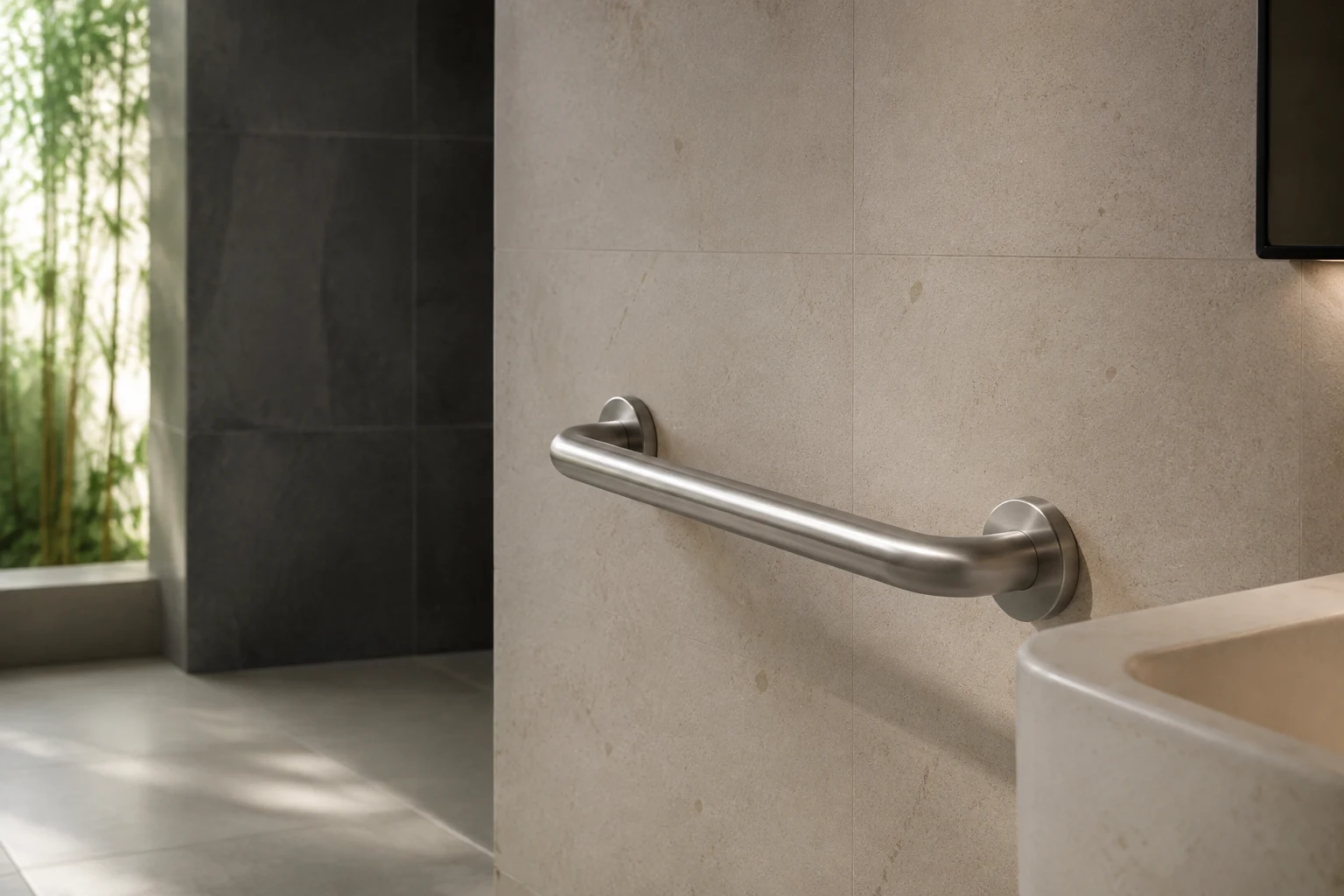
In US commercial buildings, toilet grab bars can be mounted either to the wall behind a toilet compartment or to the toilet partition itself, and both approaches appear in real projects. The right choice depends less on the rail and more on the load path: whether the structure behind the rail can carry the forces the ADA Standards require it to withstand. Before ordering, specifiers should confirm the mounting surface, the grab bar requirements in the current standards, and the partition supplier's stance on supporting rails.
The official requirements to reference
The US Department of Justice issued its ADA Standards in 2010, and the US Access Board provides the official combined standards text at https://www.access-board.gov/ada/. For toilet grab bars, the relevant sections include:
- Section 609, which addresses grab bars generally, including gripping surface, height, structural strength and clearance provisions.
- Section 609.2.1, which sets the outside diameter of circular cross-section grab bars between 1.25 and 2 inches, with 32 and 51 mm given in the standard.
- Section 609.4, which generally measures horizontal grab bar height to the top of the gripping surface, between 33 and 36 inches (840 and 915 mm) above the finish floor. Separate provisions apply to children's water closets and the lower bathtub back-wall rail, so this range should not be applied to those exceptions.
- Section 609.8, which assesses the grab bar, its fasteners, its mounting and the supporting structure together under a 250 pound (1112 N) force.
Note that Section 610 covers seats, not grab-bar requirements. It is a common mix-up in tender documents, so worth correcting early.
Why the load path matters more than the rail
Section 609.8 does not treat the bar as an isolated product. The 250 pound force is assessed across the whole assembly: the bar, the fasteners, the mounting method and the supporting structure. A rail that meets the product-level requirements can still fail the structural check if it is fixed to something that cannot carry the load.
This is why mounting decisions belong to the project designer and qualified installer, not to a catalogue entry. The mounting surface determines whether the load transfers into structure or into a panel that was never designed for it.
Wall-mounted support in partitioned compartments
In a conventional compartment, the side wall and rear wall are natural mounting surfaces. Rails fixed to solid walls or to properly backed framing transfer load into the building structure. Where the partition sits between the rail and the wall, the question becomes whether the rail can pass through or around the partition, or whether the compartment layout allows full wall mounting.
Wall mounting avoids loading the partition at all, which is often the simplest structural answer. The trade-offs are layout dependent: the transfer side, clearances and the position of the water closet all influence whether a wall-fixed rail can sit where it is needed. Those layout decisions belong with the project designer.
Partition-mounted support: what to ask the supplier
Where the design calls for rails fixed directly to toilet partitions, the partition supplier becomes part of the load path. Suppliers differ in what their panel systems are designed to accept, and some publish reinforcement or orientation requirements for accessory fixing. Questions to put to the partition supplier include:
- Is the panel construction, in the specified orientation, rated to contribute to a mounting that meets the structural requirement in Section 609.8?
- Does the supplier require reinforcement, specific panel orientation, or specific fixing zones for grab bars?
- Can the supplier provide documentation showing how their system addresses applied loads of this kind?
- Who accepts responsibility for the structural performance: the partition supplier, the rail supplier, or the installer?
A rail supplier's product documentation covers the bar. It does not cover the partition. Both sets of documentation need to exist, and neither substitutes for the project designer confirming the assembly works as a whole.
What to confirm before ordering
- Which surfaces in each compartment are available for mounting, and which are solid structure.
- Whether the design uses wall-mounted, partition-mounted or a mix, compartment by compartment.
- Rail length, diameter and gripping surface height against the current official text at https://www.access-board.gov/ada/.
- Partition supplier's requirements and documentation for accessory fixing, where partition mounting is proposed.
- That the qualified installer has reviewed the fixing conditions on site before any rails are ordered.
- That product documentation for the specific Flanso models under consideration is requested from us directly, rather than assumed from general claims.
Recording the decision in submittals
Because Section 609.8 spans the whole assembly, submittals should record the mounting surface, the partition type and orientation where relevant, the fastener approach proposed by the installer, and which documents from the partition and rail suppliers were reviewed. This gives the project designer and any reviewer a traceable record of how the structural requirement was addressed, rather than a rail specification alone.
An illustrative photo of an installed rail does not demonstrate compliance; the record does. For model-specific dimensions, finishes and documentation for Flanso grab bars, send an enquiry via https://flanso.com/#contact, and see our anchoring overview at https://flanso.com/#anchoring for general context on support rail mounting topics.
Project checklist
- Confirm the jurisdiction and cite the current official ADA Standards text, not secondary summaries.
- Check grab bar diameter against Section 609.2.1 and height against Section 609.4, watching for the children's and bathtub exceptions.
- Map each compartment: which walls are solid structure, where the partition sits, and where each rail is needed.
- Where partition mounting is proposed, obtain the partition supplier's requirements and load documentation in writing.
- Have the qualified installer review fixing conditions before ordering.
- Request model-specific documentation from Flanso for the rails under consideration.
- Record the full load path, not just the rail model, in the submittal package.