
Field notes / US
Writing a Stainless Steel Grab Bar Line Item for a US Commercial Tender
How to structure a stainless steel grab bar line item at US procurement stage: finish options, grip profiles and the supplier documentation to request, without placement advice.
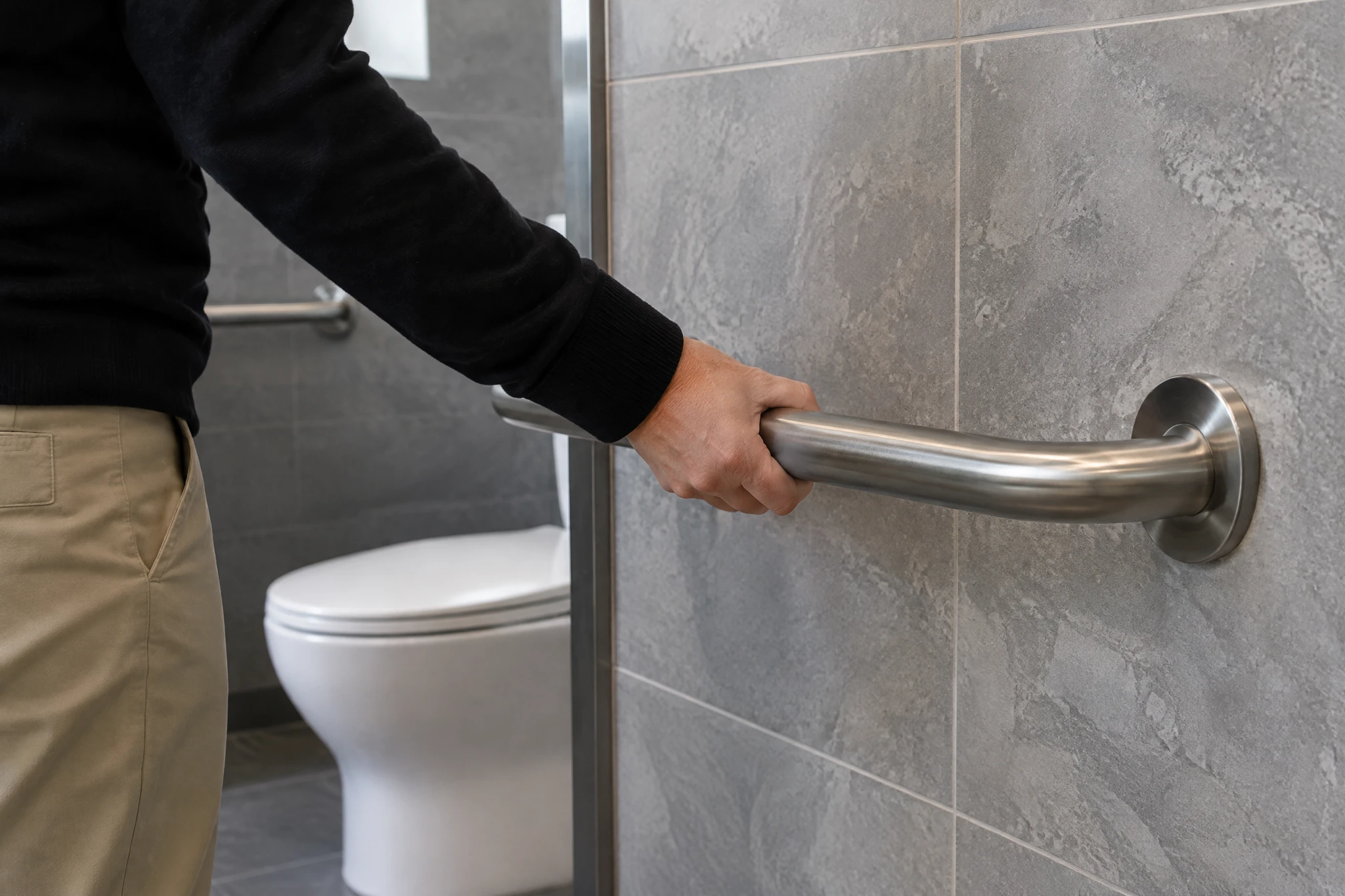
A tender-ready stainless steel grab bar line item should describe the material and finish, the grip profile and outside diameter, the mounting type, and the documentation the supplier must submit. Placement, lengths and wall construction belong to the project designer and the qualified installer, not to the procurement text. This article covers the specification stage only.
The regulatory reference to cite
For US commercial projects, the applicable framework is the 2010 ADA Standards issued by the US Department of Justice. The US Access Board publishes the official combined standards text, which is the correct citation in a tender. Section 609 addresses grab bars (https://www.access-board.gov/ada/).
Two points cause frequent drafting errors. First, section 609.2.1 sets the outside diameter of circular grab bars between 1.25 and 2 inches, with 32 and 51 mm given in the standard, so the line item's diameter tolerance must sit inside that range. Second, section 610 addresses seats, not grab-bar requirements. Do not cite 610 in a grab bar line item.
Where the tender references mounting height, note that section 609.4 generally measures to the top of the gripping surface, between 33 and 36 inches (840 and 915 mm) above the finish floor. Separate provisions apply to children's water closets and the lower bathtub back-wall rail, and the standard range does not apply to those exceptions. Since placement is not a procurement decision, it is usually cleaner to reference section 609 in the line item and leave dimensional placement to the drawings reviewed by the project designer.
Specifying the material and finish
Stainless steel is the common baseline for commercial washrooms because it withstands frequent cleaning and high traffic. At tender stage, compare finish options on the points that affect long-term performance:
- Surface treatment: polished versus satin or brushed finishes show wear and water marking differently. Ask each supplier to state the finish of the actual model quoted.
- Corrosion environment: commercial washrooms with regular cleaning regimes are demanding. Request the supplier's care and maintenance documentation for the quoted model so the cleaning contractor's regime can be matched to it.
- Consistency across the schedule: if the tender covers rails in multiple rooms, specify one finish family so replacement parts and spares remain interchangeable.
Do not accept a generic material statement in place of model-specific documentation. Ask the supplier to confirm which quoted models carry which finish and to provide the maintenance literature for each.
Grip profile and diameter
The grip profile affects comfort and usability as much as the material. Most commercial rails are circular in cross section, and section 609.2.1 of the ADA Standards permits circular outside diameters between 1.25 and 2 inches (https://www.access-board.gov/ada/). Within that range, compare:
- Diameter in relation to expected users, which the project designer and the accessibility professional should advise on.
- Surface texture: knurled or textured gripping surfaces versus smooth tube.
- Continuity of the gripping surface along the rail, and how flanges or brackets sit relative to it.
Record the chosen profile and diameter in the line item so quotes are directly comparable and the submittal can be checked against the requirement.
Strength and structural requirements in the tender
Section 609.8 of the ADA Standards requires the grab bar, fasteners, mounting and supporting structure to withstand a 250 pound (1112 N) force. This is a standard requirement of the framework, not a manufacturer's test result for any particular product.
In the tender, this means the line item should require the supplier's documentation to demonstrate how the quoted product contributes to meeting that requirement, while the fasteners, wall construction and load path are confirmed by the project designer and qualified installer. Anchoring assumptions belong in the submittal review, and coordination questions can be routed through the project's anchoring scope (https://flanso.com/#anchoring). Never accept a supplier claim that a catalogue figure alone satisfies the structural requirement without reviewing the full mounting context.
Documentation to request from suppliers
A consistent documentation request makes quotes comparable and speeds up submittal review. Ask each bidder for:
- Model-specific product data covering material grade, finish and outside diameter.
- Care and maintenance literature for the quoted finishes.
- Any mounting or fastening documentation the manufacturer publishes, for review by the qualified installer.
- Written confirmation of how the quoted model is intended to be used within a section 609.8 assembly, and clarity on what the manufacturer does and does not claim.
- Lead time, packaging and spare parts availability for the quoted models.
Keep the request identical across bidders so responses can be compared line by line.
Structuring the line item
A practical line item structure:
- Product: stainless steel grab bar, circular grip profile.
- Diameter: within the 1.25 to 2 inch (32 to 51 mm) range of section 609.2.1.
- Finish: specified finish family, with supplier to confirm per model.
- Mounting: flange or bracket type as quoted, subject to wall and load path review.
- References: 2010 ADA Standards, section 609, per the US Access Board text (https://www.access-board.gov/ada/).
- Submittals: the documentation listed above, before order confirmation.
Project checklist
- Cite the 2010 ADA Standards via the US Access Board text, section 609 for grab bars, and do not cite section 610.
- Check quoted outside diameters against the 1.25 to 2 inch range.
- Reference the 33 to 36 inch gripping-surface height provision only where the project designer confirms it applies; note the exceptions for children's water closets and the lower bathtub back-wall rail.
- Request model-specific finish, maintenance and mounting documentation from every bidder.
- Route fasteners, backing and load path to the project designer and qualified installer.
- Record the chosen finish family for spare part consistency.
- Use an identical documentation request across all bidders.
For model-specific information on Flanso stainless steel rails, including finishes and available documentation, please submit a project enquiry via https://flanso.com/#contact. Flanso does not publish blanket dimension sheets or certification claims; request the specific information for the models under consideration.